Tarun Karthick
Sri Vijaya Puram, 27 December 2025
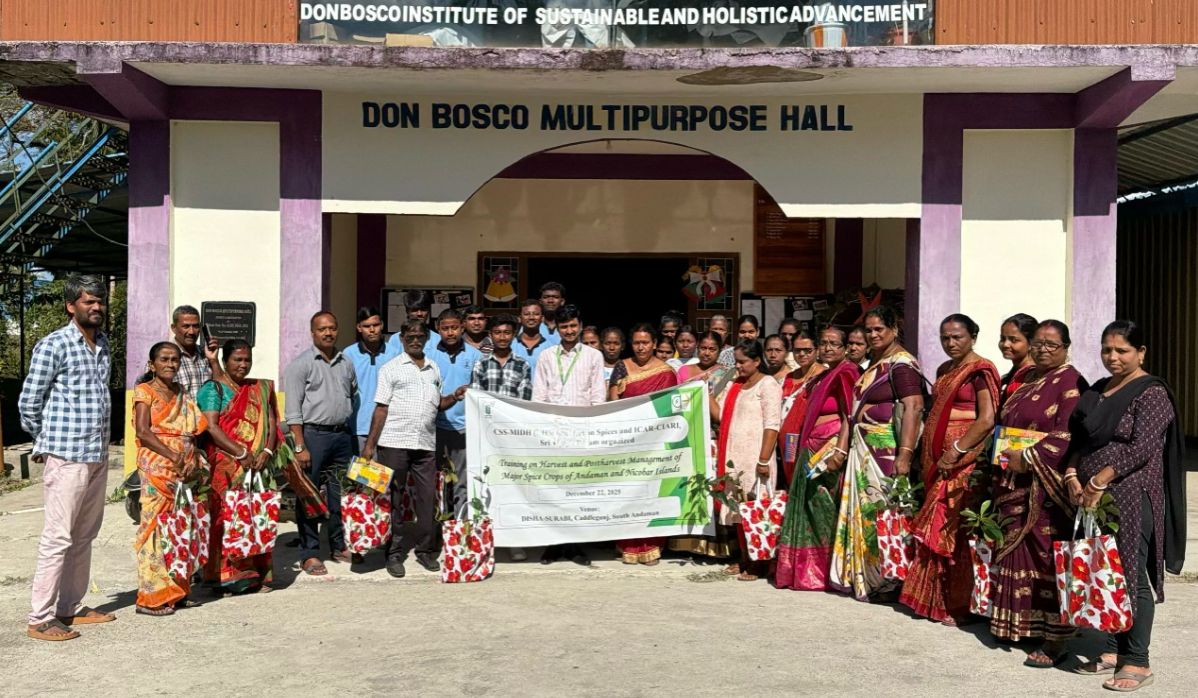
The ICAR–Central Island Agricultural Research Institute (CIAR I), Sri Vijaya Puram, conducted a training programme on Harvest and Post-harvest Management of Major Spice Crops of Andaman & Nicobar Islands at the community hall of SURABI–DISHA, Caddlegunj, on December 22, 2025.
Spices, being high-value commodities with immense potential under the agro-climatic conditions of the Andaman and Nicobar Islands, offer significant livelihood opportunities for farmers. However, lack of awareness about scientific harvesting and post-harvest practices, coupled with high humidity and prolonged rainfall, often leads to deterioration in quality and reduced market value. Keeping this in view, the programme was organised to sensitise farmers—particularly women-led Self Help Groups—on standard practices to improve quality and reduce post-harvest losses.
Addressing the participants, Dr. Ajit Arun Waman, Senior Scientist, ICAR-CIARI, highlighted the importance of scientific intervention in spice cultivation. He conducted practical demonstrations on harvesting and post-harvest handling of major spices grown in the islands. In black pepper, participants were trained on identifying maturity indices, harvesting methods, blanching techniques and proper packaging. For cinnamon, demonstrations included selection of appropriate stem size, use of the test-cut method, harvesting techniques and application of the DweepCinnRub, a cinnamon bark rubbing tool developed by ICAR-CIARI scientists, which helps improve quality while reducing labour costs.
Considering the ongoing clove harvesting season, farmers were educated on the correct stage of bud maturity, proper plucking methods and drying techniques. Processing methods for nutmeg and mace were also demonstrated to familiarise participants with these high-potential but lesser-grown spices. The training further covered cultivation prospects of Malabar tamarind, including improved varieties Dweep Agrim and Dweep Vishal, grafting techniques and mechanical processing. In view of changing climatic conditions, the relevance of foliage-based spices such as tejpat was discussed, along with information on Dweep Tej-1, the country’s first improved variety of tejpat. The islands’ indigenous spice, woody pepper, was also elaborated upon.
Dr. Waman briefed the participants on ongoing research initiatives at ICAR-CIARI and encouraged farmers to adopt large-scale cultivation of spices suited to island conditions. To support adoption, planting materials of cinnamon, black pepper, Malabar tamarind, woody pepper and lemongrass were distributed among the participants.
The training was organised under the CSS-NHM Project on Spices, funded by the Directorate of Arecanut and Spices Development (DASD), Kozhikode, Kerala, in collaboration with the Gender Research in Agriculture Cell of ICAR-CIARI. The programme was conducted by Course Directors Dr. Ajit Arun Waman and Dr. Pooja Bohra under the guidance of Dr. Jai Sunder, Director, ICAR-CIARI, and benefitted 75 stakeholders, primarily women SHG members from South Andaman. The programme was coordinated by Fr. Michael Raj, DISHA, Caddlegunj, who expressed gratitude for organising the practical-oriented training for rural stakeholders.