By Vaibhav Singh
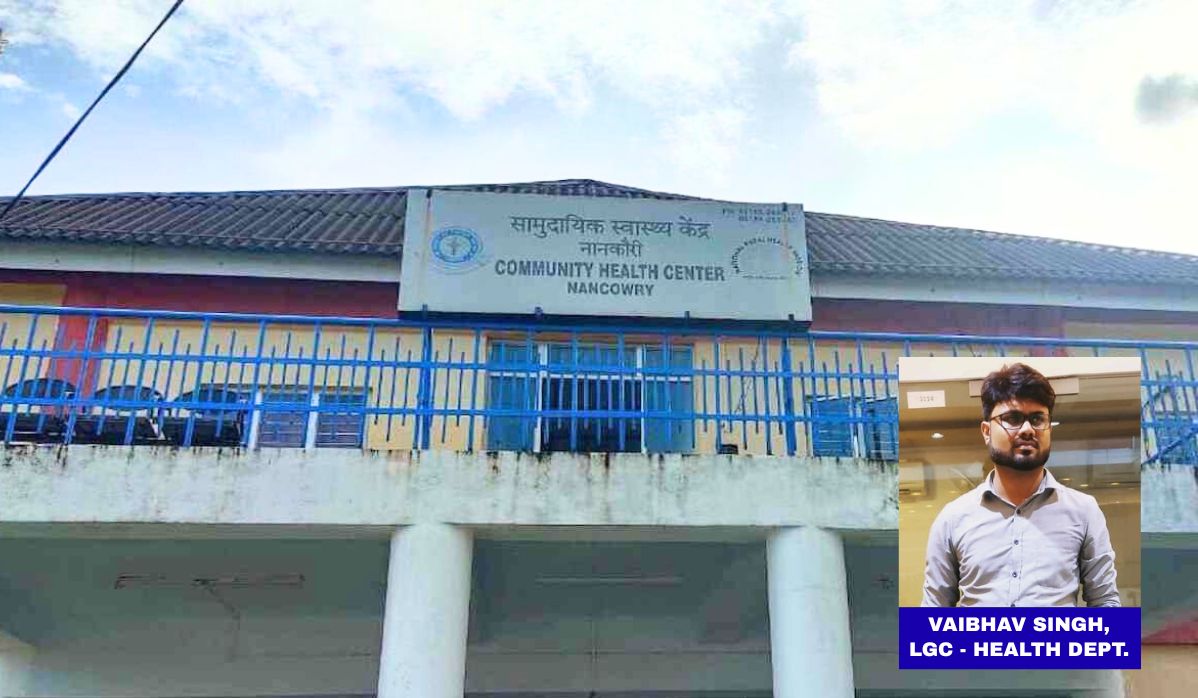
When I joined the Community Health Centre, Nancowry, on 1 November 2023 as a Lower Grade Clerk, I expected my posting to be just a procedural beginning to my government career. I did not know then that this assignment would become a lesson in public service, human bonding, and institutional transformation in one of India’s most remote tribal regions.
Coming from the idea of metropolitan efficiency, life here was a completely different reality. In Nancowry, healthcare depends on a weekly ship. If weather turns rough, medicines wait. If ration is short, the entire community feels it. Even moving a patient requires precise timing and luck.
When I joined the CHC, the situation on the administrative front was deeply challenging. Bills of several suppliers were pending, ration meant for in-patient meals was not being supplied regularly to the CHC, and bills related to patient transportation remained unsettled. The most basic facility—an RO purifier to provide safe drinking water to patients and staff—was absent. These were not just administrative gaps; they directly affected patient care and staff morale.
Very early, I realised that public service here is not about routine paperwork—it is about anticipating needs, coordinating people, and staying patient in the face of genuine limitations.
Whatever I managed to learn or contribute began with the patient guidance of Mr. Kishore Biswas, Head Clerk, Ms. Divya Menon, HGC, and Mr. Meharoz Ali, HGC. They helped me understand not just files, but responsibility. They showed me why administration must be stronger in remote tribal belts than anywhere else—because any lapse affects real lives.
CHC Nancowry is not a single hospital—it is the administrative and financial hub for:
- 11 Sub-Centres under CHC Nancowry
- PHC Katchal and its 3 Sub-Centres
- PHC Teressa and 5 Sub-Centres, plus 2 more at Chowra
Every approval, supply, salary, medicine indent, and logistical movement passed through us. In a tribal geography, administration becomes a lifeline.
I also witnessed one of the most painful moments in this institution — the sudden demise of our Chief Medical Officer, Dr. H. Charles, on 26 November 2024. His loss shook everyone. During the transition, Dr. Solomon Mark Paul took charge and worked with calm persistence to stabilise the system again.
There were times when the public raised concerns over ration or transport shortages. To them it was a grievance — for us inside, it became a mission. With limited resources, medical, clerical, and support staff worked double to ensure that healthcare delivery never stopped.
After staff transfers in July 2024, Ms. M. Hemaladha and Ms. M. Kiran joined and strengthened administration. Mr. P. Rahul also ensured that daily work never slowed down. I personally learnt something new from him almost every day.
A major transformation began when Dr. (Lt. Col.) Nirmal Kumar Bajpai joined on 17 May 2025. His disciplined approach, experience, and decisiveness quickly brought visible change. With support from Dr. Solomon Mark Paul, we achieved:
- Regularised ration supply for in-patient meals
- Better transportation support for patients
- Improved hospital cleanliness and discipline
- Stronger administrative systems
- Faster service delivery mechanisms
This was the first time I truly understood how leadership can reshape a system.
Despite shortages, our medical officers — Dr. Shabnam Salim (Homoeo), Dr. Clementine (GDMO), and Dr. M. A. Tanzeer — continued serving with unwavering professionalism. Critical to sustaining clinical services during these challenging periods was the tireless effort of Mr. Rajeev Singh, Senior Pharmacist, CMO Store, whose role proved indispensable. On several occasions, when ship services were delayed and medicine supplies risked disruption, he ensured the timely availability of essential drugs by proactively coordinating and utilising helicopter services. His commitment ensured that patient care never suffered due to logistical hurdles.
Equally instrumental was the support extended by Mr. Rathinder Kumar Nag, HGC, Directorate of Health Services, whose timely intervention in clearing long-pending bills brought significant administrative relief to CHC Nancowry, enabling smoother functioning of the institution.
But what inspired me even more were the medical officers working in places more remote than Kamorta:
Dr. Tushnik Ghosh, Dr. Rubeena Yusuf, Dr. Colin at PHC Katchal, and Dr. Priyanka and Dr. Johnson Jackson at PHC Teressa.
Their commitment ensured uninterrupted services, proper record-keeping, and constant coordination with us. They made their PHCs function at exemplary levels despite isolation.
In a tribal health system, titles mean little — effort means everything. I saw:
- Ward Attendant Mr. Shiva Subramaniyam, always helping with clerical work during pressure
- Ambulance Driver Mr. Shekar, ensuring timely patient movement despite limited transport
- Nursing Officers Ms. Jenett Wellington and Ms. Rita Chaudhury, keeping patient care seamless
People like G. Laya (Aayah), Sagar Mandal (Lab Attendant), Janezhwar (Chowkidar), and Richard (Peon) stepped beyond their duties whenever manpower fell short.
Mrs. Ayesha Majid, CTC, Nancowry Islands, extended constant cooperation and guidance in all endeavours.
At the policy level, our then Director of Health Services, Dr. Suja Antony, guided us with calm authority. Her support ensured we could continue healthcare delivery even with constraints.
Today, I can say proudly that CHC Nancowry is a fully functional healthcare institution in a tribal belt — not because resources suddenly improved, but because people chose unity, discipline, and empathy.
As the 77th Republic Day of India (26 January 2026) approaches, I look back on the period from November 2023 onward as a living example of what teamwork can achieve in remote tribal territory.
We upheld the spirit of the Constitution not through slogans, but through:
- Timely in-patient meals
- Proper patient referrals and transfers
- Clean wards
- Coordinated PHCs
- And service without complaint
This remote tribal area taught me what public service truly means.
In the most difficult geography, dedication becomes the only infrastructure.
That is how we transformed a tribal healthcare institution — one disciplined step at a time, together.