Chennai | March 11, 2026
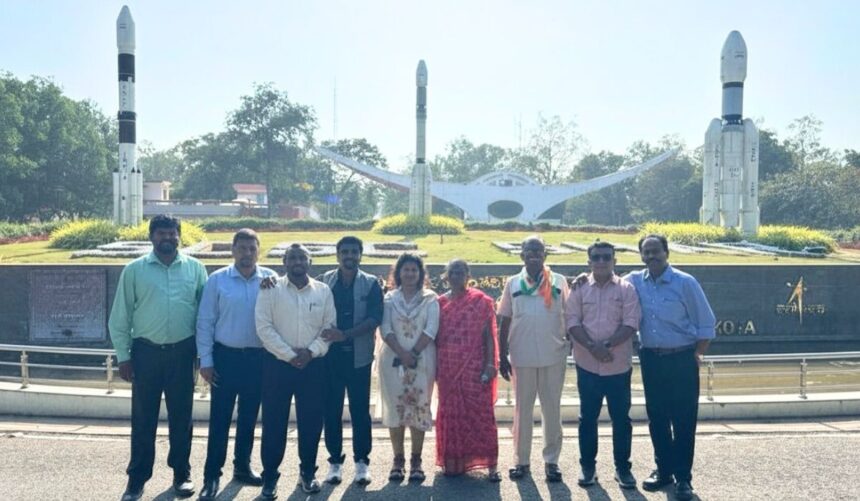
A delegation of journalists from the Andaman and Nicobar Islands, currently participating in a Press Information Bureau (PIB)-organised media tour, visited the Satish Dhawan Space Centre (SDSC SHAR) at Sriharikota, Andhra Pradesh, on March 11. The visit offered the journalists a rare opportunity to witness firsthand the infrastructure and operations of India’s premier spaceport.
Satish Dhawan Space Centre SHAR, located at Sriharikota, serves as the primary launch base of the Indian Space Research Organisation (ISRO) under the Department of Space, Government of India. Recognised as one of the prominent spaceports in the world, the centre provides world-class launch infrastructure for both national and international satellite missions, including those related to remote sensing, communication, navigation, and scientific research.
The space centre, earlier known as SHAR (Sriharikota Range), was renamed Satish Dhawan Space Centre SHAR on September 5, 2002, in honour of Prof. Satish Dhawan, former Chairman of ISRO, in recognition of his immense contributions to India’s space programme.
The origins of SDSC SHAR date back to the 1960s, when India’s pioneering space scientist Dr. Vikram A. Sarabhai laid the foundation for the country’s space research programme. With the vision of leveraging advanced technologies to address societal challenges, it was decided to establish a rocket launch station along the east coast of India, away from densely populated areas.
Sriharikota was selected in 1969 as the ideal location due to several strategic advantages, including a favourable launch corridor over the Bay of Bengal, proximity to the equator which benefits eastward launches, and the availability of vast uninhabited areas ensuring safety. The spindle-shaped island, located in the SPSR Nellore district of Andhra Pradesh, lies between the Pulicat Lake and the Bay of Bengal, with the Buckingham Canal running along its western side.
The spaceport became operational on October 9, 1971, with the launch of the Rohini-125 sounding rocket. Since then, the facilities at Sriharikota have been steadily expanded to support the growing needs of India’s space programme. Spread across approximately 43,360 acres (175 sq. km), the island has a coastline stretching nearly 50 km.
During the visit, the journalists were briefed by a senior official of the facility on the functions and achievements of ISRO and the role of SDSC SHAR in India’s expanding space capabilities. The official also interacted with the journalists and responded to their queries regarding launch operations and the country’s space missions.
As part of the tour, the delegation visited several key facilities within the spaceport. One of the highlights was the Mission Control Centre, which plays a crucial role during launch operations and is widely seen during live telecasts of rocket launches across the world. The journalists were able to experience the facility firsthand and gain insights into how missions are monitored and managed.
The delegation also visited the Launch Control Centre, which houses separate control facilities for the Polar Satellite Launch Vehicle (PSLV) and the Geosynchronous Satellite Launch Vehicle (GSLV).
Another major highlight of the visit was the tour of the Second Launch Pad, currently used for launching PSLV, GSLV, and other launch vehicles. The journalists observed the massive scale of the launch infrastructure and the advanced technology involved in launching rockets carrying critical satellite payloads for the country.
The team also visited the First Launch Pad, which is primarily used for PSLV missions. During the visit, the journalists were taken inside the launch structure and even travelled to the top level of the launch tower, located about 63 metres above ground level, offering a close view of the launch facilities.
The visit proved to be a highly educational and inspiring experience for the journalists from the Andaman and Nicobar Islands, many of whom were witnessing India’s space launch infrastructure for the first time. Being granted rare access to critical areas of the spaceport, the journalists were among the few people in the world to witness the launch facilities at such close quarters. Members of the delegation described the tour as both informative and a proud moment, highlighting India’s remarkable progress and achievements in the space sector.