Sri Vijaya Puram | February 12, 2026
In a significant step towards strengthening dairy development in the Andaman and Nicobar Islands, the Department of Animal Husbandry and Veterinary Services (AH&VS), A&N Administration, has launched the Embryo Transfer Technology (ETT) Project — the first-ever implementation of this advanced reproductive technology in livestock in the Union Territory.
Funded under the Central Government’s Rashtriya Gokul Mission, the initiative aims to rapidly upgrade the genetic quality of local cattle, enhance milk production, improve the female calf ratio and accelerate dairy self-reliance in the islands.
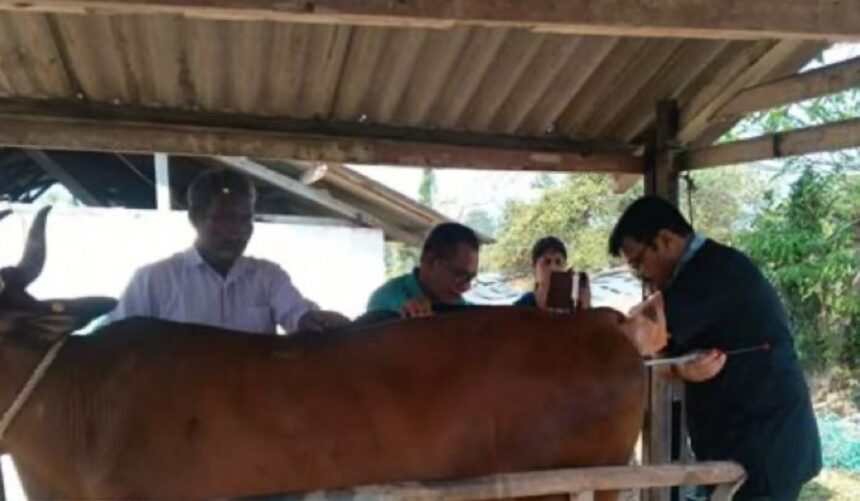
The project is being executed by NDDB Dairy Services, a pioneer in embryo transfer technology in India. The first embryo transfers were successfully performed on February 10, marking the formal commencement of ETT operations in the islands. A dedicated project team has been constituted for implementation and monitoring, with Senior Veterinary Officers from respective jurisdictions to be included as the programme progresses.
Secretary (AH&VS), Ms. Pallavi Sarkar, IAS, witnessed the embryo transfer procedure — including recipient preparation and embryo implantation — at the Government Cattle Farm, Dollygunj. Expressing confidence in the initiative, she stated that the technological intervention would mark a new beginning for the dairy sector in the islands. She highlighted that ETT enables the birth of female calves with high genetic potential for milk production, without inheriting traits from the recipient animal.
In the first phase, the project will focus on selected clusters in South Andaman. Recipient animals will be chosen based on reproductive performance and other established criteria. Owners of selected cattle will sign a Memorandum of Understanding (MoU) with the Department, and necessary documentation and health evaluations will be carried out to minimise risks and ensure optimal outcomes.
According to officials, the ETT project offers transformative benefits by enabling rapid multiplication of high-yielding, genetically superior female calves. Compared to conventional artificial insemination, the technology significantly reduces the time required for breed improvement, enhances milk yield potential, curbs the unwanted male calf population and strengthens the economic viability of dairy farming for island farmers.
The initiative forms part of the Department’s long-term vision to achieve self-sufficiency in milk production, improve nutritional security and uplift rural and tribal livelihoods through the adoption of modern reproductive technologies.
The Department has stated that the project will be scaled up to additional clusters and islands in subsequent phases to cover major milk-producing areas across the UT. Interested cattle owners have been advised to contact their nearest veterinary institution for further information and to avail benefits under the scheme.