Sri Vijaya Puram | April 8, 2026
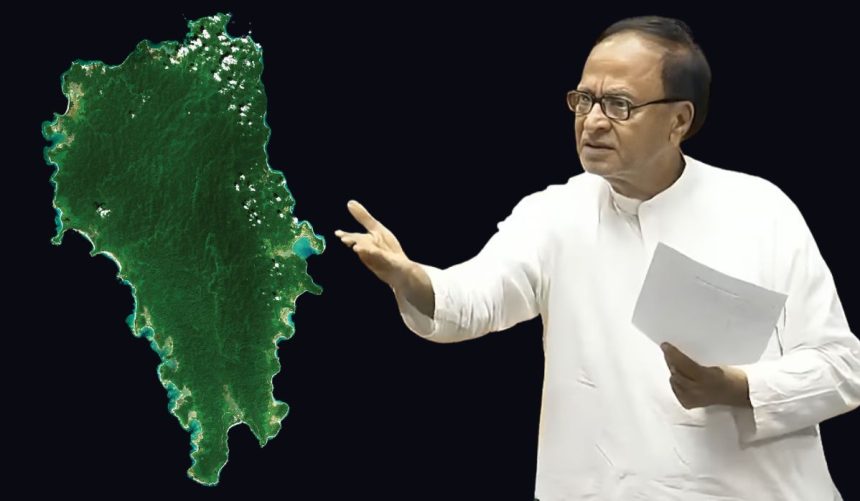
Mr. Bishnu Pada Ray, Member of Parliament from Andaman and Nicobar Islands, has submitted detailed objections and suggestions on the Draft Master Plan for the Great Nicobar Island Development Area, urging the Administration to clearly distinguish between newly proposed strategic development zones and long-settled revenue villages on the island.
In his representation, the MP clarified that he is not opposed to development in Great Nicobar. He expressed support for a structured planning framework in areas earmarked for major strategic infrastructure, trunk services, environmental safeguards, and large project-driven developments. According to him, such newly conceived zones warrant a formal and detailed planning approach.
However, Mr. Bishnu Pada Ray strongly objected to the application of the same complex planning regulations to old revenue villages, which have evolved organically over time. He noted that these villages are established habitations with livelihoods rooted in agriculture, fisheries, trade, and local services, and should not be treated as newly planned urban townships.
The MP cautioned that the current draft risks over-regulating these villages through extensive land-use zoning, subdivision rules, setbacks, parking norms, and other technical restrictions. He stated that such provisions are more suitable for new urban expansions and could prove administratively unfair and impractical for existing village settlements.
Highlighting policy concerns, Mr. Ray pointed out that the draft appears inconsistent with the Union Territory’s broader policy direction of deregulation and reducing compliance burdens. He stressed that governance frameworks should aim for minimal zoning, greater permissibility, mixed land use, reduced prior approvals, and the elimination of unnecessary No Objection Certificates (NOCs).
He further observed that instead of simplifying governance, the draft introduces additional classifications, layers of control, and increased administrative oversight, which contradicts the principle of a light-touch and village-sensitive regulatory approach.
Proposing a way forward, the MP recommended a dual-track model. He suggested that while the detailed master plan should continue for strategic and project-based zones, existing revenue villages should be governed under a simplified development and regularisation framework. This, he said, should include limited zoning, default mixed-use provisions, a short list of restricted activities, simplified construction norms, and outcome-based regulation rather than approval-heavy processes.
Emphasising the need for balanced development, Mr. Bishnu Pada Ray stated that progress in Great Nicobar must align with administrative practicality, policy consistency, and fairness to long-settled residents. He urged the Administration to revisit provisions affecting existing villages before finalising the Draft Master Plan.
“Development in Great Nicobar must move forward, and strategic project zones can certainly have a detailed planning framework. But old revenue villages cannot be treated as if they are newly created urban townships. Long-settled residents should not be burdened with an overdesigned and permission-heavy system merely due to upcoming large projects,” the MP said in his submission.