Tarun Karthick
Sri Vijaya Puram, 25 September 2025
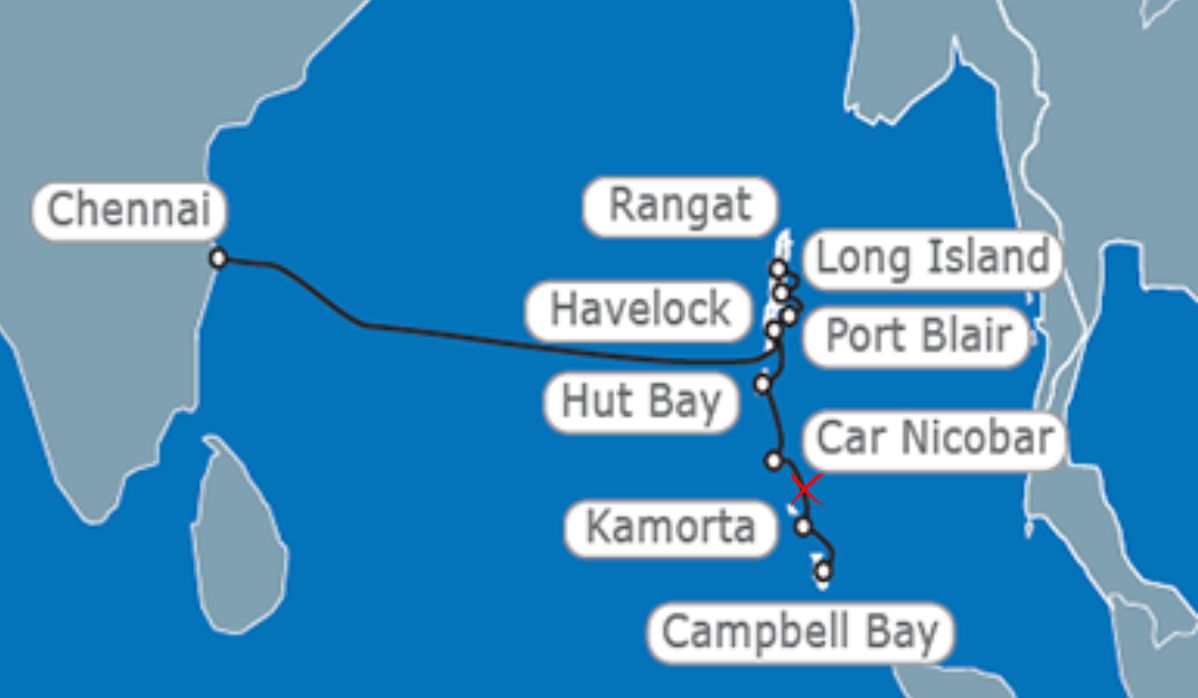
On 20th September at around 3:32 p.m., residents of Nancowry and Great Nicobar experienced a sudden and complete communications blackout, severing internet, telephone, and other digital connectivity with the mainland and other parts of the Andaman and Nicobar Islands. Preliminary investigations traced the cause to a fault in the Car Nicobar – Kamorta Segment of Chennai–Andaman and Nicobar Islands (CANI) Submarine Optical Fibre Cable (OFC), the primary digital lifeline connecting the Andaman and Nicobar Islands to the world. Until the fault is repaired, Nancowry and Great Nicobar must rely on limited satellite bandwidth, which authorities are prioritizing for essential services such as voice communications, banking, and administrative operations.
According to sources familiar with the diagnostics, the fault is located approximately 1,060 metres (1.06 km) from the Beach Manhole at Car Nicobar, placing it firmly in the submarine segment of the cable. Usually cable faults are identified using tools like Optical Time Domain Reflectometers (OTDRs), which send pulses of light down the fiber. When the cable is damaged or severed, some light reflects back, allowing engineers to calculate the distance to the fault with high accuracy. Monitoring of power feeds to the underwater repeaters, which amplify signals along the route, also provides critical clues about the nature of the fault. Typically, these methods allow operators to detect the approximate location within a few hours, although the exact cause and type of fault — whether a complete break, partial damage, or equipment failure — is confirmed only after a repair ship retrieves and inspects the cable on the seabed.
Submarine cable faults are generally classified into three categories. Complete cuts, caused by anchors, fishing trawlers, undersea landslides, or natural disasters, result in total signal loss and require the damaged section to be physically retrieved, replaced, and relaid. Partial damage, such as bends, cracks, pressure marks, or marine life interference, may degrade signals but still necessitates retrieval and repair. Equipment failures, including malfunctioning repeaters, also disrupt connectivity and require specialised intervention. Repairs involve complex operations using grapnels and Remotely Operated Vehicles (ROVs) to lift, test, splice, and re-lay the cable, a process that can take several days to weeks depending on location, sea depth, and weather conditions.
As per available public information, the maintenance and operation of the CANI cable are governed by a tripartite agreement signed on 13 November 2020 between three parties: the Andaman & Nicobar Administration, the Universal Service Obligation Fund (USOF) under the Department of Telecommunications, and Bharat Sanchar Nigam Limited (BSNL). Under this arrangement, the A&N Administration bears the annual operation and maintenance cost of ₹46.8 crore, while USOF funded the capital cost of ₹1,212 crore for the construction of the project. BSNL acts as the implementing agency, responsible for managing all network elements, handling warranty arrangements with NEC Technologies India Private Limited (a subsidiary of NEC Corporation Japan) for equipment, and coordinating maintenance of the submarine portion through SEAIOCMA (South East Asia and Indian Ocean Cable Maintenance Agreement).
It is important to note that SEAIOCMA is not a company but a cooperative maintenance agreement comprising approximately 45 submarine cable owners and operators. Members pool resources to maintain submarine cables across a vast region stretching from Djibouti in the west to Guam in the east, Taiwan in the north to Perth, Australia in the south, covering roughly one-third of the world’s oceans. SEAIOCMA itself does not perform repairs but contracts specialized marine service companies to carry out maintenance. The primary contractors include the Global Marine Group (UK), which operates the vessel Cable Retriever from Subic Bay, Philippines, and ASEAN Cableship Pte Ltd (Singapore), which operates four vessels — ASEAN Explorer, ASEAN Restorer, ASEAN Protector, and ASEAN Challenger. Other regional operators, including Indian Ocean Cable Ship Ltd., also provide support. These vessels maintain 24-hour mobilization readiness, are strategically positioned for rapid deployment, and are equipped with advanced ROVs and cable-handling systems capable of retrieving, testing, splicing, and burying cables on the seabed.
For the CANI system, SEAIOCMA coordinates the deployment of these vessels whenever a fault occurs in the submarine segment, ensuring timely repair in line with the agreement managed by BSNL. Until the repair is completed, southern Nicobar Islands must depend on limited satellite connectivity, a stark reminder of how vulnerable remote island communities are to disruptions in submarine communication infrastructure. The tripartite agreement, along with the back-to-back arrangements with NEC Infrastructure and SEAIOCMA, was designed to ensure uninterrupted quality of service.