Sri Vijaya Puram | March 23, 2026
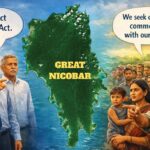
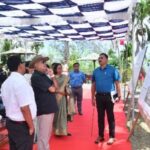
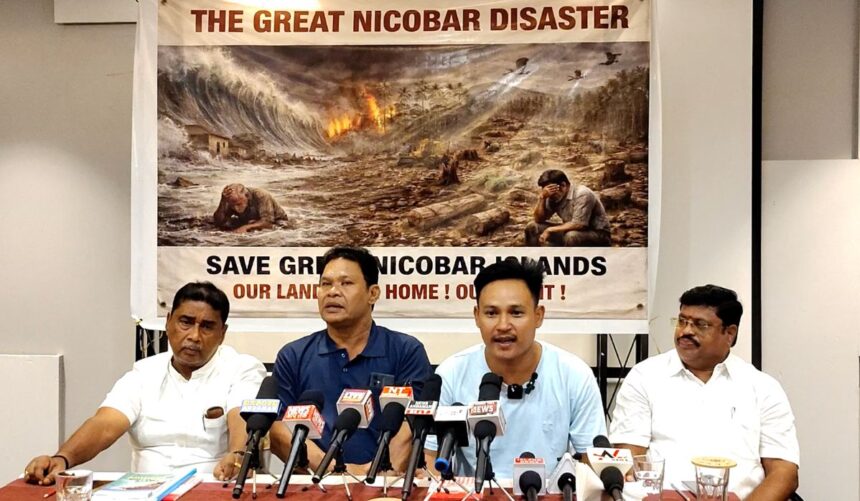
A press conference on the proposed Great Nicobar Project was held on March 23, 2026, at Hotel TSG Emerald View in Sri Vijaya Puram, where leaders of the Andaman and Nicobar Territorial Congress Committee along with representatives of the Tribal Council of Great Nicobar and Little Nicobar presented detailed concerns regarding the project following their recent visit to New Delhi. The delegation had met Leader of Opposition in the Lok Sabha, Rahul Gandhi, and submitted a representation outlining environmental, social, and livelihood-related apprehensions linked to the project.
Addressing the media, Tamil Selvam, Spokesperson of the Andaman and Nicobar Territorial Congress Committee, stated that the Great Nicobar project has emerged as one of the most significant issues in the islands. He explained that the project, proposed through NITI Aayog with an estimated investment of around ₹92,000 crore, includes an international airport, a township, a 450 MW power plant, and a transshipment port. While stating that development is necessary and inevitable, he raised serious concerns regarding the scale of land acquisition and environmental consequences. He noted that around 130 square kilometres of land is proposed to be acquired and that while official figures suggest 8.5 to 10 lakh trees will be felled, statistical estimates indicate that the number of mature trees in the area could be close to one crore. He questioned the lack of transparency regarding how such a massive volume of timber would be managed, transported, and utilised.
Selvam further linked the issue to declining rainfall patterns and increasing water scarcity in the islands. He stated that rainfall has reduced significantly in recent years and pointed out that in South Andaman, water supply has already become irregular, with households receiving water only once in several days. He warned that large-scale deforestation could further worsen the ecological balance and water crisis. He emphasised that tourism remains the backbone of the islands’ economy and that environmental degradation could directly affect livelihoods dependent on it. He also criticised compensatory afforestation plans in mainland states, stating that such measures cannot replace ecological loss in island ecosystems. He stressed that indigenous communities such as the Nicobarese and Shompen are the original inhabitants and should be taken into confidence before implementing such projects.
Barnabas Manju, Chairperson of the Tribal Council of Great Nicobar and Little Nicobar, stated that the tribal community is not opposed to development but is concerned about the impact on their land, culture, and way of life. He recalled that during the public hearing held on January 22, 2022, it was stated that tribal villages would not be affected by the project, but later maps suggested otherwise, creating confusion and concern. He explained that the Nicobari community depends on forests for livelihood, housing, and daily needs, and that their traditional way of life has already been disrupted after the 2004 tsunami, when multiple villages were destroyed and people were resettled in areas such as Rajiv Nagar and New Chingen. He said that earlier the community lived self-sufficiently, but now many are forced into wage labour, including women, which marks a major change in their lifestyle.
Manju emphasised that the primary demand of the community is to return to their ancestral villages rather than accept compensation. He stated that repeated representations have been made to authorities but no satisfactory response has been received. He reiterated that development should not destroy their cultural identity or traditional way of living.
T.S.G. Bhasker, Chairperson of the Campaign Committee of the Andaman and Nicobar Territorial Congress Committee, provided a historical perspective, stating that Great Nicobar was originally inhabited by Nicobari and Shompen communities and that tribal communities had voluntarily given land in the past for defence and settlement without seeking compensation. He argued that the present project is being implemented without adequate consultation and questioned its scale. He suggested that if the project is meant for national security, it could be carried out in a much smaller area. He also raised concerns about environmental impacts such as deforestation, soil erosion, and damage to marine ecosystems.
As the press conference moved into an extended question-and-answer session, journalists raised pointed questions regarding the position of the tribal community. One of the first questions sought clarity on whether the tribal leadership was opposing the project entirely or only its current form. Responding to this, Barnabas Manju clarified that the community is not against development but is primarily concerned about land loss and displacement. He reiterated that their consistent demand has been to return to their original villages rather than remain confined to resettlement areas.
Another question referred to a meeting reportedly convened by the district administration regarding tribal welfare plan and asked whether the tribal leadership had participated. Manju responded that he was unable to attend the meeting due to connectivity issues.
Journalists then raised the issue of national security, noting that the Government of India has repeatedly described the project as strategically important. They pointed out that tribal communities have historically supported national interests, including by giving land for settlement and defence purposes, and asked whether the community would support the project if their interests were protected. Responding to this, Manju acknowledged the importance of national security but emphasised that several villages would be affected by the current project plan. He stated that multiple traditional villages fall within the proposed project area and that people want to return to those villages rather than lose them permanently.
A detailed technical question was also raised regarding the project area and the proposed de-notification and re-notification of tribal reserve land. The question suggested that while a portion of tribal land would be acquired, additional areas would be re-notified as tribal reserve, resulting in a marginal net increase. Responding to this, Manju maintained that the core issue is culturally significant areas. He reiterated that affected communities want to return to their original villages and that their land should not be taken away.
Another significant line of questioning focused on employment. Journalists pointed out that the project is being projected as a major source of employment and it would benefit local communities. Responding sharply, Tamil Selvam rejected this claim and described it as misleading. He stated that thousands of government posts—estimated at around 14,000—are already vacant in the islands across departments such as Public Works, Education, Agriculture, and Forests, and questioned why these vacancies have not been filled if employment generation is a priority. Mr. Bhasker further alleged that even positions reserved for tribal candidates have been filled by individuals from outside the islands, citing examples to argue that local communities may not benefit from the project’s employment opportunities.
Bhasker also raised broader concerns during the exchange, questioning the economic and environmental viability of the project. He pointed to the scale of land acquisition, the proposed relocation of coral colonies, and the potential ecological damage, stating that there is insufficient independent scientific assessment. He warned that large-scale deforestation could lead to soil erosion, which in turn could damage marine ecosystems, including coral reefs.
The discussion also touched upon the issue of compensation and rehabilitation. Journalists asked whether tribal communities would be willing to accept compensation packages similar to those being offered to settlers, including housing and employment support. In response, tribal representatives made it clear that monetary compensation would not be an acceptable substitute for the tribal community.
Following this, Mr. Titus, First Captain of Pulo Babi village, addressed the media and provided a detailed ground-level perspective. Introducing himself as a resident of Pulo Babi currently living in Rajiv Nagar, he stated that the tribal community has not been clearly informed about the project. He said that they have not been told how much land will be acquired or what specific components will be developed, and described the process as lacking transparency.
Titus stated that while he is not against development, he is uncertain about its long-term consequences and whether it will create difficulties for the community in the future. He raised concerns about potential impacts on forests, wildlife, coral reefs, and marine ecosystems, and questioned whether these would survive after the project is implemented. He warned that large-scale tree felling could cause irreversible environmental damage and expressed concern about the community’s vulnerability in the event of natural disasters such as another tsunami.
He emphasised that development should be carried out carefully and not at a scale that destroys the entire ecosystem. He also raised concerns about decision-making, stating that officials implementing the project are not local residents and may leave in times of crisis, whereas local communities would have to bear the consequences. He further stated that even now, there is no clear and final information about the project, with multiple maps creating confusion among residents.
Titus highlighted that many of the areas included in the project are places where tribal communities traditionally lived, and reiterated that people want to return to those areas. He pointed out that current resettlement locations such as Rajiv Nagar do not provide adequate livelihood opportunities, particularly for plantation-based activities, and that people continue to face economic hardship. He stated that despite outward appearances, the community is not truly content in resettlement areas and continues to struggle.
He further explained that earlier, communities depended on forests for their needs, including materials for festivals and daily life, but are now forced to purchase these items, reflecting a loss of traditional self-sufficiency. He reiterated that the community has repeatedly demanded to be resettled in their original villages and has raised these concerns in meetings and through written representations, but has not received adequate responses.
Responding to a question on compensation, Titus questioned where the government would provide alternative land, noting that existing revenue areas are already occupied. He stated that even if housing is provided, it may be on their own land. He asserted that the land belongs to the community and that its value cannot be measured or replaced through compensation, especially when considering the future of coming generations.
He further stated that if proper rehabilitation was intended, it should have been implemented earlier, particularly in the years following the tsunami, before initiating such a large-scale project. He emphasised that tribal consent must be obtained before proceeding and that communities should be fully informed about the project. He also pointed out that during meetings with officials, discussions have largely focused on issues in resettlement areas rather than the project itself, indicating a lack of direct engagement on the core issue.
The delegation also informed that during their meeting in New Delhi, Rahul Gandhi listened to their concerns in detail, assured them that the issue would be raised in Parliament, and expressed willingness to visit the islands to understand the situation firsthand.