Sri Vijaya Puram | November 4, 2026
Dakshin Foundation, in collaboration with the Directorate of Education, DDE Science Wing, and with support from Axis Bank Foundation, has conducted three phases of teacher training workshops on Treasured Islands, a place-based environmental education resource book designed specifically for middle school teachers in the Andaman and Nicobar Islands.
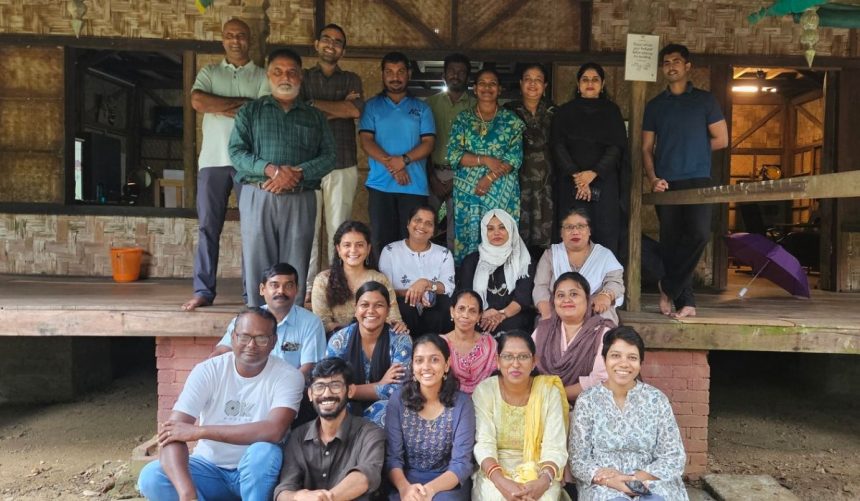
Through the three phases of workshops, Dakshin Foundation has trained 58 teachers from 49 schools in South Andaman. The training sessions were held at the Andaman and Nicobar Environment Team (ANET) field station at North Wandoor.
Place-based learning connects classroom concepts with students’ local environment, culture and lived experiences, helping them develop a deeper understanding of the unique ecosystems of the Andaman and Nicobar Islands and their significance.
Originally published in 1996 by Kalpavriksh and ANET, Treasured Islands laid an important foundation for environmental education in the islands. The fourth edition of the book was launched in September 2025 by Dr. Chandra Bhushan Kumar, former Chief Secretary of the Andaman and Nicobar Islands.
The revised edition, developed by Dakshin Foundation and Srishti School of Art, Design and Technology, with inputs from the Directorate of Education, is aligned with the CBSE curriculum and presents environmental concepts in a more engaging and locally relevant manner.
The two-day workshops comprised indoor and outdoor sessions focusing on the importance of place-based and contextual education, highlighting how connecting classroom learning with local ecosystems can make education more meaningful for students.
A key highlight of the first day was a guided tree walk around the ANET campus, during which teachers explored local biodiversity and learned how textbook concepts such as forest ecology, food webs and nutrient recycling could be taught through the islands’ forests. Several participants shared that the walk helped them reconnect with nature and brought back memories of their childhood.
Dedicated sessions were also conducted to familiarise teachers with the structure and content of Treasured Islands. Participants explored various chapters, discussed effective ways of using the resource and identified overlaps with existing NCERT textbooks to facilitate classroom integration.
Teachers worked in groups to prepare and present sample lesson plans using island-based examples for NCERT topics. They also exchanged ideas and reflected on ways to adapt the activities to suit the specific contexts of their respective schools.
At the conclusion of the workshops, teachers expressed greater familiarity and confidence in using the resource. They said they were motivated to incorporate island-specific examples into their teaching to make learning more relatable and meaningful for students. Participants also highlighted that Treasured Islands helps address gaps in the existing curriculum by providing a rich collection of locally grounded examples and activities.
The resource is expected to be widely used in Environmental Studies classes, Eco Clubs and subjects such as Science and Social Science across schools.
Through initiatives such as these, Dakshin Foundation and the Directorate of Education aim to strengthen environmental learning in the islands and foster a deeper connection between young learners and the unique ecosystems they call home.