Sri Vijaya Puram | May 18, 2026
The Draft Master Plan for the Great Nicobar Island Development Area–2047 released by the Andaman and Nicobar Administration has projected massive employment generation and population growth in the island over the coming decades through the development of multiple economic sectors including port operations, tourism, finance, processing industries, defence, wellness and knowledge-based services.
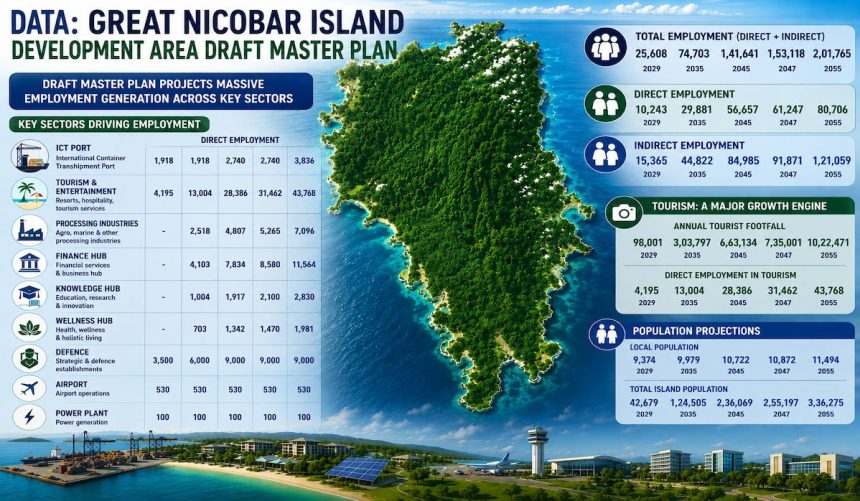
According to the draft document, the proposed development model for Great Nicobar is based on key economic drivers such as the International Container Transshipment (ICT) Port, Tourism & Entertainment, Processing industries, Finance Hub, Knowledge Hub and Wellness Hub. The DMP estimates that these sectors together will generate a total employment of 25,608 by 2029, which is projected to rise sharply to 74,703 by 2035, 1,41,641 by 2045, 1,53,118 by 2047 and eventually 2,01,765 by 2055.
The draft states that total direct employment across all sectors is expected to reach 10,243 by 2029. This figure is projected to increase to 29,881 by 2035, 56,657 by 2045, 61,247 by 2047 and 80,706 by 2055.
Indirect employment, which includes jobs generated in supporting sectors and services, has been estimated at 15,365 by 2029. The number is projected to increase to 44,822 by 2035, 84,985 by 2045, 91,871 by 2047 and 1,21,059 by 2055.
The tourism sector is expected to emerge as the largest contributor to employment generation under the proposed development plan. The draft estimates annual tourist footfall at 98,001 by 2029, increasing to 3,03,797 by 2035, 6,63,134 by 2045, 7,35,001 by 2047 and over 10,22,471 annually by 2055. Correspondingly, direct employment in the tourism sector is projected at 4,195 by 2029, 13,004 by 2035, 28,386 by 2045, 31,462 by 2047 and 43,768 by 2055.
The ICT Port sector is projected to provide 1,918 direct jobs beginning in 2029 and 2035, increasing to 2,740 jobs by 2045 and 2047, and further rising to 3,836 by 2055.
The Processing sector is projected to generate no direct employment initially by 2029, but employment is expected to rise to 2,518 by 2035, 4,807 by 2045, 5,265 by 2047 and 7,096 by 2055.
The proposed Wellness Hub is expected to create 703 direct jobs by 2045, increasing to 1,342 by 2047 and 1,981 by 2055.
Similarly, the Knowledge Hub is projected to generate 1,004 direct jobs by 2035, 1,917 by 2045, 2,100 by 2047 and 2,830 by 2055.
The Finance Hub, which is envisioned as one of the major future economic drivers of Great Nicobar, is projected to generate 4,103 direct jobs by 2035. This is expected to rise to 7,834 by 2045, 8,580 by 2047 and 11,564 by 2055.
The defence sector is also expected to contribute significantly to employment generation, with projections estimating 3,500 direct jobs by 2029, 6,000 by 2035 and 9,000 jobs from 2045 onwards.
Employment associated with the airport project has been estimated at 530 direct jobs consistently from 2029 onwards, while the proposed power plant is expected to generate 100 direct jobs throughout the projected period.
The draft further projects that the overall population of Great Nicobar Island would witness a substantial increase due to migration linked to economic activities and employment opportunities. The local population, estimated at 9,086 in 2025, is projected to increase to 9,374 by 2029, 9,979 by 2035, 10,722 by 2045, 10,872 by 2047 and 11,494 by 2055.
However, the total island population, including migrant workers and their dependents, is estimated to rise much more significantly — from 42,679 in 2029 to 1,24,505 by 2035, 2,36,069 by 2045, 2,55,197 by 2047 and eventually 3,36,275 by 2055.
The draft document explains that the employment projections for the port sector were based on data received from the Syama Prasad Mukherjee Port Trust (SMPK). Tourism sector projections, including tourist footfall and employment generation, were estimated using benchmarks from developed island destinations such as Seychelles, Mauritius, Maldives and St. Lucia, with tourism employment estimated at 4.28 percent of annual tourist footfall.
The projections for Processing, Wellness Hub, Knowledge Hub and Finance Hub were prepared by benchmarking similar developments across the region and adapting them to the Great Nicobar context. Employment estimates for the airport, defence and power plant sectors were based on data provided by the concerned agencies.
The DMP has further stated that indirect employment has been calculated at 1.5 times the direct employment generated by the major sectors, based on experiences from greenfield development projects across the country. These indirect jobs are expected to include services such as education, healthcare, retail trade, commercial establishments, recreational activities, home support and safety services.
The draft also notes that the migration of both skilled and unskilled workers to the project site is expected to lead to the gradual migration of dependents as well. The overall population estimates for Great Nicobar have therefore been prepared assuming a workforce participation rate of 60 percent, taking into account the island’s locational characteristics.