Sri Vijaya Puram | January 21, 2026
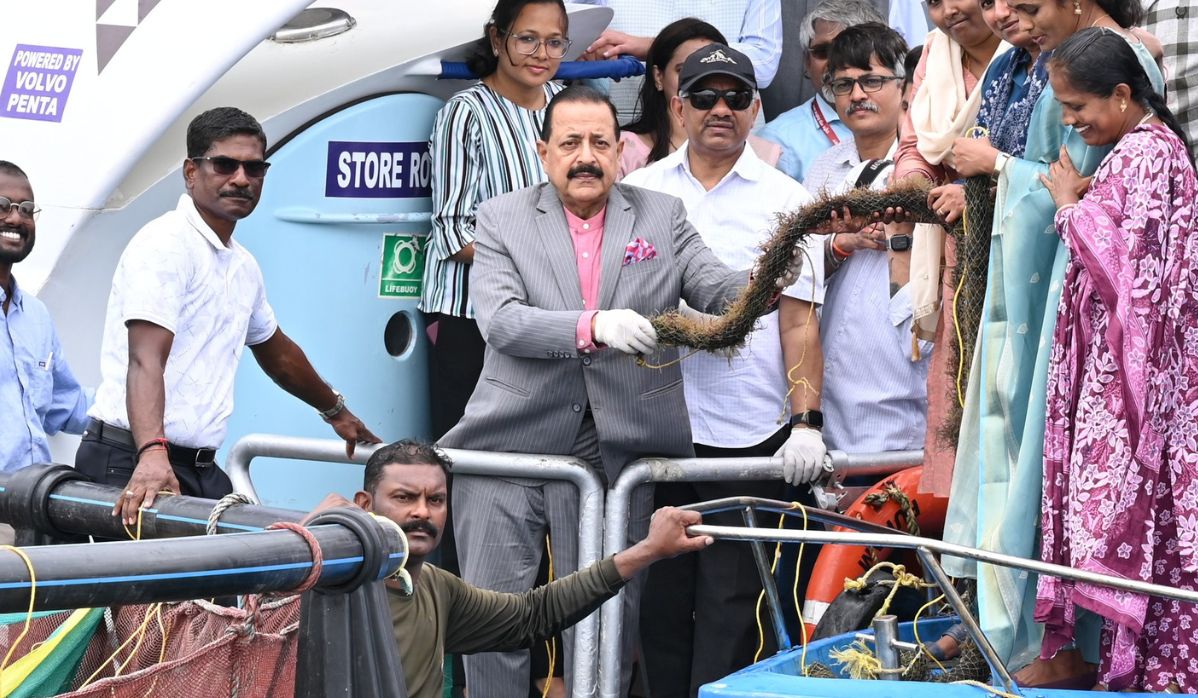
On 18th January 2026, Union Minister of State (Independent Charge) for Science & Technology and Earth Sciences, Dr Jitendra Singh, launched India’s first open-sea marine fish farming project in the Andaman and Nicobar Islands. The project was inaugurated during a field visit to North Bay, off Sri Vijaya Puram, marking a rare instance of a major science-led initiative being launched directly in open waters rather than from a conference venue.
What is this project about?
The project is a pilot initiative aimed at cultivating marine fish and seaweed in the open sea using cage-based farming systems, instead of relying entirely on traditional capture fishing. It is being implemented through a collaboration between the Ministry of Earth Sciences, its technical arm the National Institute of Ocean Technology (NIOT), and the Andaman & Nicobar Administration.
Under the initiative, NIOT-designed open-sea cages, capable of operating in natural ocean conditions with waves and currents, have been deployed to rear marine finfish. Alongside this, open-sea seaweed cultivation has been introduced as a parallel activity. As part of the launch, finfish seeds and seaweed seeds were handed over to local fishing communities.
How is open-sea marine fish farming different from traditional fishing?
Traditional marine fishing largely depends on locating and catching wild fish stocks, often requiring fishing vessels to travel long distances into the sea. This involves high fuel costs, physical risk, dependence on weather conditions, and uncertainty about the final catch.
Open-sea marine fish farming works on a different principle. Instead of searching for fish, fish are reared in fixed cages placed in the open ocean, where they grow under natural sea conditions. Fishermen and coastal communities are involved in managing, feeding, and harvesting the fish, rather than chasing migrating stocks.
In simple terms, it is a shift from “catching fish” to “farming fish.”
What are the advantages of marine fish farming over capture fishing?
While outcomes will depend on scale and implementation, open-sea marine fish farming is widely seen as having several potential advantages:
- It can reduce long-distance fishing trips, helping lower fuel use and operational costs
- It may offer more predictable harvests and incomes, compared to the uncertainty of daily fishing
- It helps reduce pressure on wild fish stocks, supporting marine conservation
- It allows fishing communities to diversify livelihoods, rather than depend solely on capture fisheries
These benefits are particularly relevant for island territories like the Andaman and Nicobar Islands, where fishing costs are high and marine ecosystems are ecologically sensitive.
Why is this important for the Andaman and Nicobar Islands?
The Andaman and Nicobar Islands are surrounded by vast and diverse ocean resources, yet much of this potential has historically remained underutilised. By introducing open-sea aquaculture and seaweed farming, the project opens up new livelihood options for local communities while aligning with environmental protection goals.
Seaweed cultivation, in particular, is being promoted as a low-impact, livelihood-oriented activity with growing demand in sectors such as food products, pharmaceuticals, and industrial applications. Combined with cage-based fish farming, it provides an additional income stream suited to island conditions.
A step towards India’s Blue Economy vision:
During the launch, Dr Jitendra Singh described the initiative as an important step towards strengthening India’s Blue Economy, a policy approach that seeks to balance economic growth with sustainable use of ocean resources. He noted that India’s maritime domain—across different seaboards—offers diverse opportunities that are only now beginning to receive focused attention.
While the current initiative is being carried out through government-led collaboration, the experience gained from this pilot is expected to inform future expansion, including the possibility of public–private participation to scale up operations and livelihood benefits.
Why this project matters?
India’s first open-sea marine fish farming pilot in the Andaman Sea represents a strategic shift in thinking about ocean use. Rather than extracting more from the sea through increased fishing effort, the project explores how science, technology, and community participation can be combined to create sustainable economic activity in open waters.
For the Andaman and Nicobar Islands, the initiative has the potential to gradually reshape coastal livelihoods—making them safer, more predictable, and environmentally responsible—while positioning the region as a testing ground for India’s future ocean-based development.