Sri Vijaya Puram | March 27, 2026
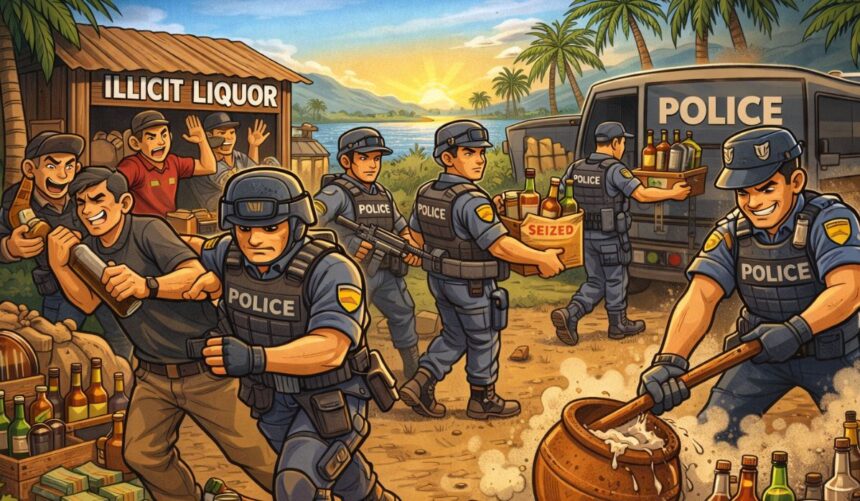
Illegal liquor trade continues to pose one of the most persistent law-and-order challenges in the Andaman and Nicobar Islands, with offences related to illicit distillation, transportation, and sale of both local brews and Indian Made Foreign Liquor (IMFL) accounting for a substantial share of registered cases. Despite periodic enforcement drives, the problem remains deeply entrenched, driven by the ease of entry into the trade, low social stigma, and relatively lenient penalties that fail to act as a strong deterrent. Repeat offenders frequently return to the same illegal activities, exposing significant gaps in the existing enforcement framework.
At present, the Andaman and Nicobar Police primarily rely on the Andaman and Nicobar Islands Regulation, 1876 (Regulation III of 1876), a colonial-era law, to deal with liquor-related offences. However, a far more stringent and contemporary legal framework already exists in the form of the Andaman and Nicobar Islands Excise Regulation, 2012, promulgated by the Hon’ble President of India. This regulation provides for considerably harsher penalties, including imprisonment ranging from up to three months to seven years, along with fines between ₹50,000 and ₹1,00,000 or up to five times the value of the seized liquor, whichever is higher. In cases involving repeat offenders, the punishment can be doubled, making the regulation a potentially powerful deterrent against illegal trade.
Despite these robust provisions, the 2012 regulation has not been effectively utilised on the ground. The key reason lies in a critical administrative gap, as the Andaman and Nicobar Police have not been granted the necessary powers to act under this regulation. As per Section 9 of the regulation, the Hon’ble Lt. Governor, in his capacity as the Administrator of the Islands, has the authority to extend the powers of an Excise Officer to non-excise personnel through a notification. However, even after more than a decade since the regulation came into force, this enabling provision has not been utilised to grant necessary powers to the police, leaving the police constrained to act under outdated and less stringent laws.
This lack of empowerment has had a direct impact on enforcement effectiveness, as police officials remain unable to invoke the stronger penal provisions of the 2012 regulation. Interactions with officers indicate that while cases are regularly booked, the absence of stringent punishment under the applicable law often results in offenders treating enforcement as a minor setback rather than a serious consequence. This has allowed illegal liquor networks to continue functioning with relative ease across various parts of the Islands.
Extending the powers of the Excise Officer to the police under the 2012 regulation is widely seen as a potential turning point in tackling this issue. With access to stronger legal provisions, police would be in a better position to pursue cases more effectively, ensuring stricter punishment and creating a meaningful deterrent against both existing and prospective offenders. Such a move could significantly disrupt the cycle of repeat offences that currently characterises liquor-related crimes in the Islands.
The issue also extends beyond enforcement and into the social domain, as the widespread availability of illicit liquor has contributed to growing concerns around alcohol dependency. Reports from across the Islands indicate that illegal liquor is often accessible at all hours and, alarmingly, even to underage individuals. This unrestricted access is exacerbating alcohol-related social and health problems within communities, making the need for stronger regulation and enforcement all the more pressing.
The continued delay in empowering the police under the Andaman and Nicobar Islands Excise Regulation, 2012 has thus emerged as a major bottleneck in effectively addressing liquor-related crimes. As illegal alcohol traders continue to exploit existing loopholes, the urgency for adopting a stronger and more modern enforcement mechanism cannot be overstated. Granting the necessary powers to the police may well prove to be a game-changer in curbing illegal liquor trade in the Andaman and Nicobar Islands, provided the administration takes timely and decisive action.