Sri Vijaya Puram | June 17, 2026
The Department of Agriculture has urged farmers across the Andaman and Nicobar Islands to take advantage of financial assistance available under the Centrally Sponsored Scheme – Mission for Integrated Development of Horticulture (MIDH) for establishing protected cultivation structures.
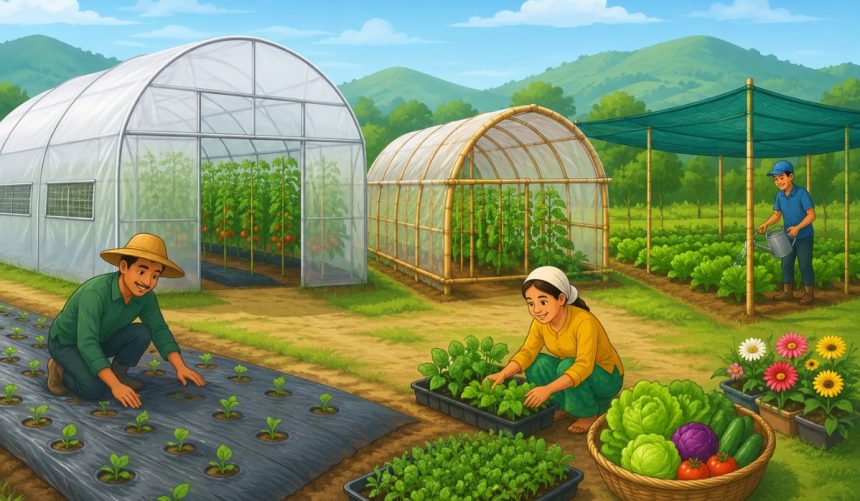
Protected cultivation has emerged as an effective solution for farmers to overcome adverse weather conditions, improve water-use efficiency and enhance agricultural productivity. These structures are particularly beneficial for cultivating off-season vegetables, raising quality nurseries and growing high-value flower crops.
Under the scheme, eligible farmers will receive financial assistance for setting up various protected cultivation structures, including Naturally Ventilated Poly Houses, Bamboo/Cable Purlin Poly Houses, Shade Net Houses and Weed Mats.
According to MIDH guidelines, farmers can avail subsidy assistance amounting to 50 per cent of the approved cost for establishing these structures. For Naturally Ventilated Poly Houses with tubular structures, subsidy is available up to Rs. 690 per square metre for a maximum area of 2,500 square metres per beneficiary. For Naturally Ventilated Poly Houses and Shade Net Houses with bamboo/cable purlin structures, subsidy is available up to Rs. 517.50 per square metre, subject to a maximum area of 2,500 square metres per beneficiary.
Similarly, farmers can avail 50 per cent subsidy for Weed Mats, limited to Rs. 57.50 per square metre, for a maximum area of 4,000 square metres per beneficiary. Subsidy for smaller areas will be provided on a pro-rata basis as per MIDH norms.
The department has advised interested farmers to contact the Zonal Officers and extension staff posted in their respective jurisdictions for detailed information, submission of applications and guidance on availing subsidy benefits under the scheme.
Farmers have been encouraged to make optimum use of the scheme to adopt modern horticulture practices, increase crop productivity and improve farm income.