Sri Vijaya Puram | October 12, 2026
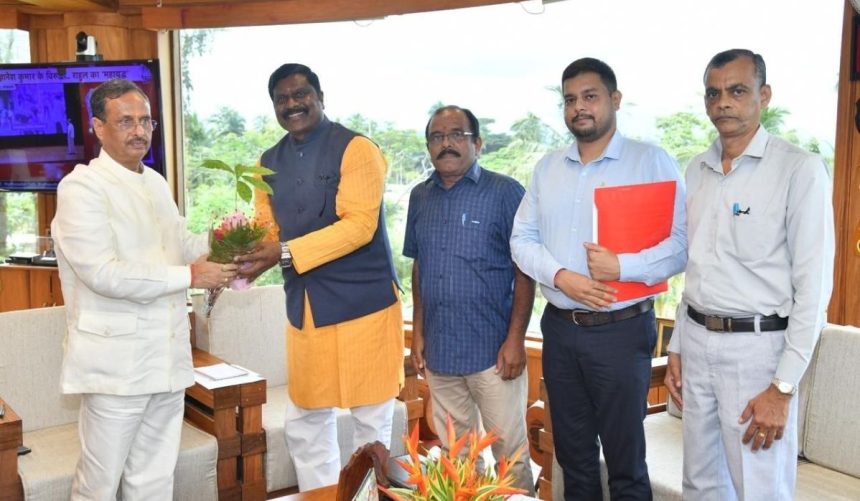
E. S. Rajesh, Pramukh, Panchayat Samiti Campbell Bay, Great Nicobar, and President of the Dependents and Ex-Servicemen Forum for Equitable Negotiation, Compensation & Entitlements – Great Nicobar Island (DEF-GNI), on October 12 called on the Lt. Governor of Andaman and Nicobar Islands at Lok Nivas and presented a series of demands concerning land acquisition for various components of the Great Nicobar Island Project and other pressing issues affecting local residents.
The delegation included Mr. Bhoop Singh, permanent resident of Great Nicobar; Mr. Sriram Singh, permanent resident of Great Nicobar and Advocate; and Mr. Tarun Karthick, permanent resident of Great Nicobar and Editor of Nicobar Times.
During the meeting, the delegation broadly discussed concerns relating to land acquisition, compensation, rehabilitation and resettlement of affected families in connection with various components of the Great Nicobar Island Project. The Lt. Governor assured the delegation that the people of Great Nicobar would not be allowed to suffer due to land acquisition.
The representations highlighted the circumstances of Ex-Servicemen Settler Families, many of whom have lived on the island for generations and have faced repeated displacement, including following the 2004 tsunami. While reiterating their support for the Great Nicobar Island Project and its stated national objectives, DEF-GNI sought fair compensation, adequate rehabilitation and resettlement benefits, and measures to ensure that affected families continue to have a meaningful stake in the island’s future development.
A major demand was the revision of circle rates or the adoption of an alternative mechanism to ensure fair compensation for agricultural land acquired for the project. The forum pointed out that the prevailing circle rates in Great Nicobar’s villages are low and may result in inadequate compensation. It proposed compensation of ₹1 crore per acre of agricultural land as an acceptable level for the affected community.
The delegation also sought the inclusion of all eligible family members aged 18 years and above in the displaced-person category for rehabilitation and resettlement benefits, including those residing in Sri Vijaya Puram, other islands or mainland cities for education, employment, business and livelihood-related reasons. It argued that temporary residence outside Great Nicobar should not deprive eligible adult family members of benefits when their original homes are affected by acquisition.
The forum demanded that each eligible adult member of an Ex-Servicemen Settler Family be allotted at least 1,000 square metres of land in Great Nicobar to establish a residence, maintain a kitchen garden and undertake animal husbandry or other livelihood activities.
It further sought the construction of spacious reinforced cement concrete (RCC) houses for each eligible beneficiary, with two bedrooms, three bathrooms and toilets, a drawing room, dining area, verandah and backyard. Alternatively, affected beneficiaries should receive financial assistance equivalent to the cost of constructing such a house in Great Nicobar.
Another key demand concerned the Permanent Tsunami Shelters allotted to affected families after the 2004 tsunami. DEF-GNI sought recognition of these shelters as the rightful property of their respective allottees and demanded that compensation for acquired properties cover the land, plantation, structure and any additions, improvements or modifications made by occupants.
The forum also requested that a minimum standard value be fixed for plantation crops and that applicable compensation and other benefits be provided over and above these values. The proposed minimum values include ₹53,760 for coconut, ₹33,345 for arecanut, ₹1,00,800 for mango, ₹10,500 for guava, ₹28,000 for jackfruit, ₹37,800 for tamarind, ₹36,750 for clove, ₹24,500 for cashew nut, ₹16,800 for jamun, ₹6,300 for cinnamon, ₹2,625 for bay leaves and ₹6,300 for drumstick.
Seeking enhanced support for families facing displacement, DEF-GNI demanded rehabilitation and resettlement benefits equivalent to five times the benefits ordinarily prescribed under the Right to Fair Compensation and Transparency in Land Acquisition, Rehabilitation and Resettlement Act, 2013.
For affected individuals who do not opt for employment under the rehabilitation and resettlement package, it proposed minimum lump-sum financial assistance of ₹25 lakh, or alternatively, enhanced annuity benefits equivalent to five times the standard prescribed amount.
For those opting for employment, the forum sought a legally enforceable guarantee of permanent employment in Government departments or public sector undertakings, to be provided within one year from the date of land acquisition. It also demanded enhanced compensation for livestock affected by the acquisition of agricultural and residential land.
The representation further sought that the components of the Great Nicobar Island Project intended to facilitate planned urbanisation and development be treated as acquisition for urbanisation purposes wherever applicable under the law. On this basis, DEF-GNI requested the extension of the 20% developed-land entitlement under the Second Schedule of the 2013 Act to eligible affected land-owning families, in proportion to the land acquired, so that they can retain an economic stake in the island’s future development rather than depend solely on one-time compensation.
In a separate representation concerning local civic issues, Mr. Rajesh sought ownership rights for families allotted Permanent Tsunami Shelters following the 2004 tsunami, including the legal heirs of deceased allottees.
The representation stated that the absence of ownership rights has restricted families from undertaking necessary repairs, structural modifications and extensions, even as the ageing wooden structures require maintenance and the size of families has increased over the years. It also raised concerns about fire safety and difficulties faced by families when the original allottees have passed away, including reported concerns over the continuation of electricity connections in the names of deceased allottees.
The representation sought the allotment of the land adjacent to and surrounding these shelters to the respective allottees or their legal heirs to enable them to maintain, repair and expand their homes according to their present requirements.
The delegation also raised the need to strengthen transportation links between Sri Vijaya Puram and Campbell Bay in view of the increased movement of officials, consultants, private company personnel and other passengers associated with the Great Nicobar Island Project.
It sought an increase in ship sailings between Sri Vijaya Puram and Campbell Bay from the existing one sailing per week to two sailings per week. It also requested additional helicopter sorties alongside the Indian Air Force Dornier service, which operates to Campbell Bay twice a week, on Tuesdays and Thursdays.
The representation pointed out that cancellations of Dornier services can create a backlog of passengers travelling for urgent purposes. It proposed arranging additional helicopter services for officials, consultants and private company personnel travelling to Great Nicobar for project-related work, allowing regular scheduled services to be prioritised for local residents.
The delegation further sought the early commencement of the proposed UDAN flight service between Sri Vijaya Puram and Campbell Bay via Car Nicobar, citing the need for affordable and regular air connectivity for residents, project-related travellers and tourists.
The restoration of free air transportation for patients referred by Government doctors at the Primary Health Centre in Great Nicobar for advanced treatment in Sri Vijaya Puram was another demand.
The representation stated that the earlier facility had been withdrawn, causing hardship to economically weaker families who may be unable to afford air travel for medical treatment. It sought free transportation on scheduled air services for all patients referred by Government doctors, noting that while emergency evacuations are provided free of cost, patients travelling through scheduled services are charged the Islander fare.
The delegation highlighted recurring shortages of LPG and other essential fuels due to dependence on private cargo shipping operators. It cited a recent shortage during which LPG was unavailable in Great Nicobar for nearly four months because no cargo vessel was available for transportation.
To prevent such disruptions, the representation urged the Administration to consider chartering or procuring cargo vessels capable of transporting LPG cylinders, petrol and diesel to Great Nicobar, thereby reducing dependence on the availability of private shipping operators.
It also raised concerns over frequent load shedding caused by shortages of High Speed Diesel (HSD) required for electricity generation. The representation attributed the problem to delays in fuel transportation by the private contractor responsible for supplying HSD and the absence of adequate buffer stocks on the island.
The delegation sought directions to ensure timely transportation of HSD and maintenance of sufficient fuel stocks to avoid electricity disruptions.
The representation called for the immediate resumption of Smart Islander Card issuance at the Office of the Assistant Commissioner, Campbell Bay, where technical problems with the card-printing machine and related equipment have reportedly halted the process.
It also sought the reopening of applications for fresh inclusion of eligible residents, including spouses and children of Islanders, in the Islander Card database. The representation noted that these cards are required to avail subsidised ship and helicopter tickets and that the lack of cards is causing inconvenience to residents.
The delegation sought the provision of two additional buses for the STS Unit in Great Nicobar to improve services on existing routes and help ensure uninterrupted public transportation, particularly given the challenges of maintaining buses in the remote region.
It also called for streamlining the process of obtaining No Objection Certificates (NOCs) for developmental works proposed by Gram Panchayats, the Panchayat Samiti and the Zilla Parishad. According to the representation, delays in obtaining clearances from various authorities, including the Town Planner, have hindered local development works even where funds are available.
The delegation proposed empowering appropriate local authorities, such as the Tehsildar, to issue NOCs for Panchayati Raj Institution projects wherever permissible, enabling developmental works to be undertaken without unnecessary delays.
The representations collectively sought a fair and humane approach to land acquisition, adequate rehabilitation of affected families, and improvements in transportation, healthcare access, essential supplies, electricity and local governance. The delegation emphasised that the development of Great Nicobar should safeguard the interests and livelihoods of its existing residents while allowing the island to progress.