Campbell Bay | September 17, 2026
The recent registration of NDPS cases at Police Station Campbell Bay and seizures of drugs from youths have once again highlighted concerns over the growing availability and movement of narcotic and psychotropic substances in Great Nicobar.
Campbell Bay was considered relatively free from drug abuse a few years ago. However, the presence of drugs on the island has gradually emerged as a concern, mirroring the broader issue being witnessed in different parts of the Islands.
Great Nicobar’s geographical location and maritime connectivity make the island particularly vulnerable to the movement of contraband. Cargo and passenger vessels travelling from Sri Vijaya Puram to Great Nicobar generally pass through intermediate island(s) before reaching Campbell Bay, which is generally the last port of call on the route.
While the detection and checking mechanisms at Sri Vijaya Puram are comparatively more stringent, they cannot be considered completely leak-proof. The possibility of narcotic substances being introduced at different points along the maritime route also cannot be ruled out, especially on ships calling at multiple remote intermediate ports. The concern is particularly significant at intermediate islands where screening of passenger baggage and cargo is more limited, potentially providing opportunities for drugs to be concealed and transported onward to Great Nicobar.
The Andaman and Nicobar Islands have previously witnessed several instances of narcotic substances being recovered after being found washed ashore, while cases involving the transportation and trade of drugs between islands have also been reported. Such incidents underline the need for stronger detection mechanisms not only at the primary point of departure, but also at intermediate ports and at the final destination.
In the case of Great Nicobar, Campbell Bay generally being the last port of call for cargo and passenger vessels makes the jetty an important point at which the movement of contraband could be detected. Effective screening of passenger baggage and cargo could add another layer of protection against the possible inflow of narcotic and psychotropic substances.
At present, police personnel in Campbell Bay are reportedly detecting narcotic and psychotropic substances through intelligence-led operations. While intelligence gathering and targeted operations remain important, these efforts could be further strengthened through systematic screening of passengers, baggage and cargo at the point of entry and exit.
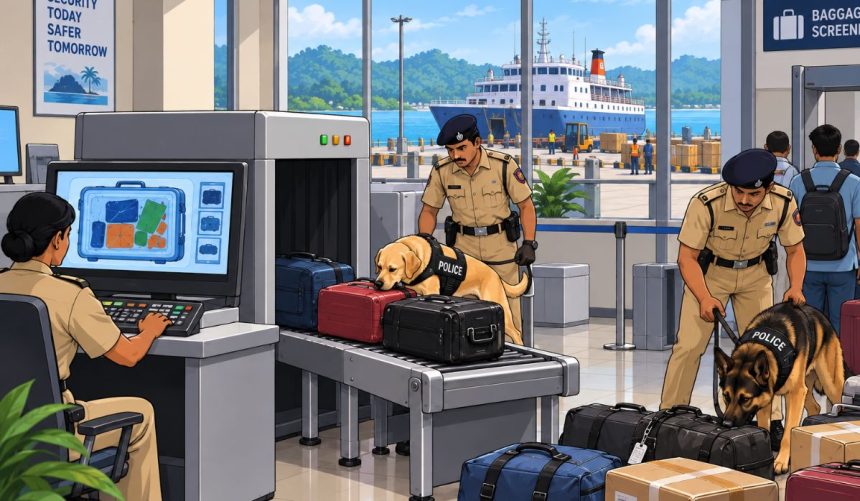
A permanent police canine unit trained in the detection of narcotic substances could further strengthen these efforts. Such a unit could assist in screening passengers and baggage arriving at Campbell Bay, as well as cargo being transported to the island. Trained canine teams could also support intelligence-led anti-narcotics operations conducted within Great Nicobar.
The installation of an X-ray baggage scanning system capable of detecting concealed items could provide an additional layer of security for screening passenger baggage and cargo.
The need for stronger safeguards is also relevant from the perspective of the movement of drugs out of Great Nicobar. There have been concerns regarding illicit substances being transported out of the island through ships, including in connection with drugs that were earlier reportedly washed ashore and allegedly stored illegally by some anti-social elements. Screening during both entry and exit could therefore help address the possible movement of narcotics in either direction.
The requirement assumes greater significance given the strategic importance of Great Nicobar and the ongoing development initiatives on the island. The Government of India is implementing the Great Nicobar Island Project, making the need to maintain a secure environment and prevent the proliferation of narcotic substances among the local population particularly important.
The spread of drugs can have serious social consequences, particularly for young people. Strengthening detection mechanisms at key maritime entry and exit points could help law enforcement agencies and create a stronger deterrent against illicit trafficking.