Tarun Karthick
Sri Vijaya Puram, 17 December 2025
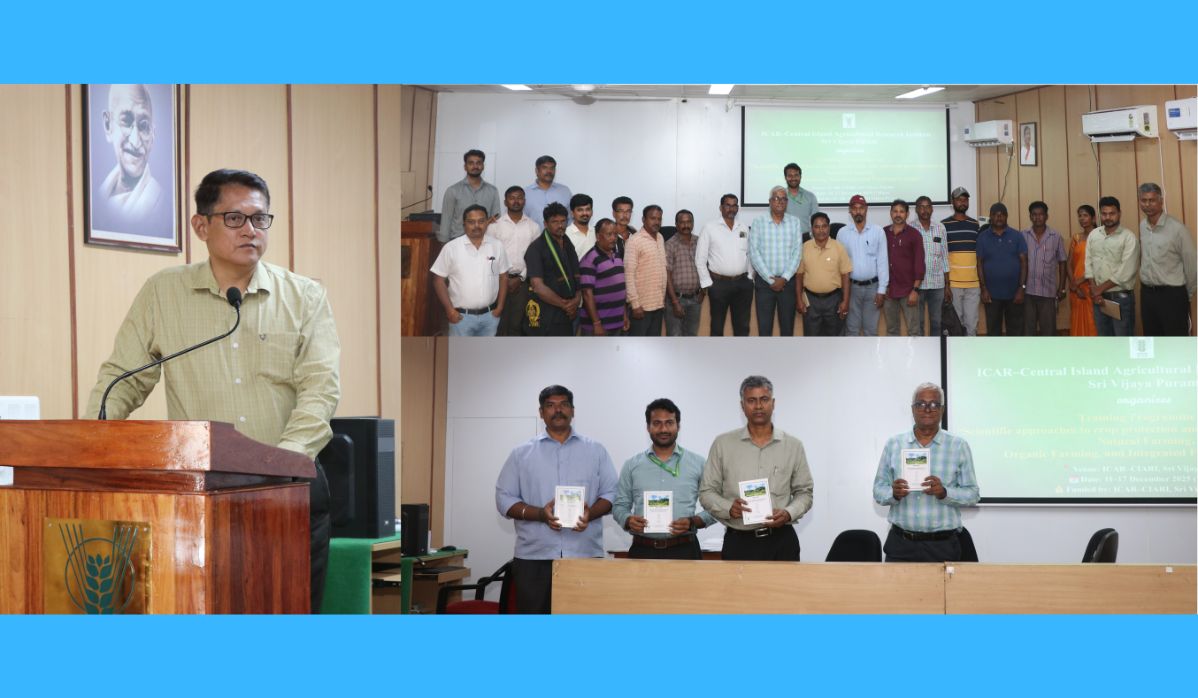
The ICAR–Central Island Agricultural Research Institute (CIARI) successfully conducted a week-long training programme on “Scientific Approaches to Crop Protection and Nutrient Management in Natural Farming, Organic Farming and Integrated Farming Systems” from December 11 to 17, 2025, at its campus in Sri Vijaya Puram.
The programme was organised with the aim of enhancing the knowledge and practical skills of technical staff and participants in adopting chemical-free, sustainable and scientifically validated farming practices tailored to the agro-ecological conditions of the Andaman & Nicobar Islands. The training focused on strengthening field-level capacity to promote natural, organic and integrated farming systems among island farmers.
Key aspects covered during the programme included scientific pest and disease management, nutrient management and on-farm resource recycling. Participants received hands-on training in the preparation and application of Jeevamrit, Beejamrit, Ghan Jeevamrit, vermicompost, botanical extracts, and the use of microbial bioagents such as Trichoderma and Pseudomonas, along with other eco-friendly crop protection practices.
The programme was inaugurated by Dr. Jai Sunder, Director, ICAR–CIARI, who underscored the importance of adopting sustainable and climate-resilient agricultural practices to address the unique challenges of island agriculture. Dr. R. Kiruba Sankar, Nodal Officer (HRD), highlighted the role of continuous capacity building and skill development in strengthening ICAR’s human resources.
The training was coordinated by Dr. I. Jaisankar, Dr. Y. Ramakrishna, Dr. Abhilash and Dr. Prabhu as Course Directors. Dr. I. Jaisankar elaborated on the objectives and relevance of the programme, while Dr. Y. Ramakrishna explained the course structure and training modules designed to meet field requirements. Resource persons from the Division of Natural Resource Management and Krishi Vigyan Kendra, Sippighat, South Andaman, supported the conduct of the programme.
Pre- and post-training evaluations indicated a significant improvement in participants’ knowledge levels, reflecting the effectiveness of the initiative. The programme concluded with positive feedback from participants, who appreciated the hands-on demonstrations and field-oriented approach. A training manual titled “प्राकृतिकखेती, जैविकखेतीएवंएकीकृतकृषिप्रणालीमेंफसलसंरक्षणएवंपोषकतत्वप्रबंधनहेतुआवश्यकआदान” was released and distributed as a practical reference for future field application.