Sri Vijaya Puram | April 2, 2026
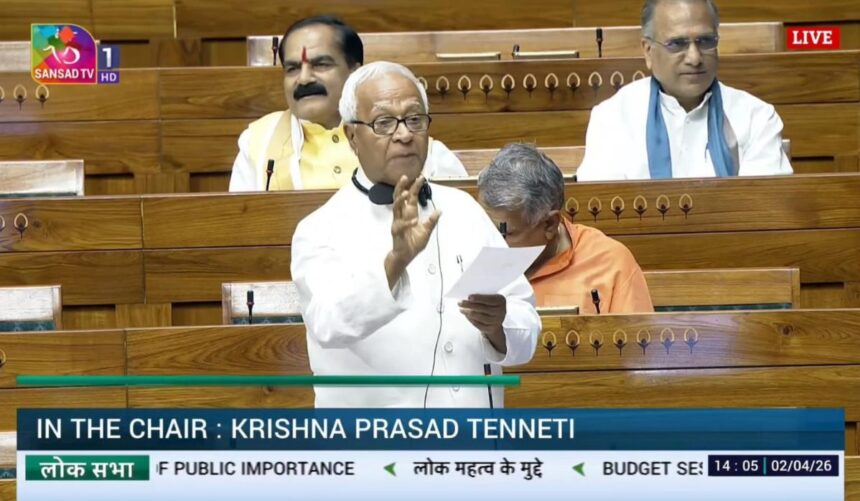
Hon’ble Member of Parliament from Andaman & Nicobar Islands, Mr. Bishnu Pada Ray, on Thursday raised a significant issue in the Lok Sabha during Zero Hour (Diary No. 10390 dated 02.04.2026), seeking a fair compensation and rehabilitation package for families likely to be affected by the proposed mega infrastructure project in Great Nicobar Island.
Highlighting concerns related to residents of Gandhinagar and Shastri Nagar in Campbell Bay, Mr. Ray drew the attention of the Government towards the potential displacement and livelihood impact arising from the ambitious Great Nicobar Island Project (GNI), being undertaken by the Government of India under the leadership of Prime Minister Mr. Narendra Modi.
Describing the project as one of strategic and economic importance, Mr. Ray noted that it aims to transform Great Nicobar into a major international trade and logistics hub, with the potential to rival established centres such as Singapore and Hong Kong. However, he stressed that development must not come at the cost of local communities.
The MP emphasized that all affected families must be provided with fair and adequate compensation along with comprehensive rehabilitation measures. He urged that the process be carried out strictly in accordance with the provisions of the Right to Fair Compensation and Transparency in Land Acquisition, Rehabilitation and Resettlement Act, 2013.
Mr. Ray proposed that land valuation should be fixed at Rs. 1.50 crore per hectare, along with due compensation for houses, plantations, and loss of livelihoods. Citing precedents, he referred to compensation frameworks adopted in earlier projects, including the GMR-led airport development project in Delhi. In this context, he also strongly advocated for a “land-for-land” compensation model, ensuring that displaced families are provided with alternative land in lieu of the land acquired, as part of a just and sustainable rehabilitation policy.
Concluding his intervention, Mr. Ray made a humble appeal to the Prime Minister to consider granting a comprehensive and equitable rehabilitation package. He underscored that many of the affected families were originally settled under government rehabilitation schemes and have already endured multiple hardships, including the devastation caused by the 2004 Indian Ocean Tsunami.
He reiterated that safeguarding the rights and future of these families must remain a priority alongside national development goals.