Sri Vijaya Puram | September 5, 2026
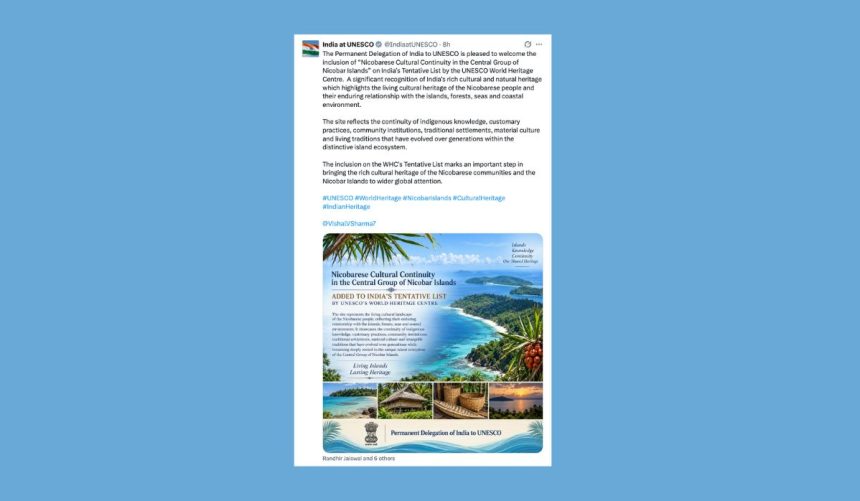
The cultural heritage of the Nicobarese people has received significant international recognition with the inclusion of “Nicobarese Cultural Continuity in the Central group of Nicobar Islands” on India’s Tentative List of properties for possible inscription on the UNESCO World Heritage List.
The development was welcomed by the Permanent Delegation of India to UNESCO, which said the inclusion by the UNESCO World Heritage Centre represents a significant recognition of India’s rich cultural and natural heritage. It highlights the living cultural heritage of the Nicobarese people and their enduring relationship with the islands, forests, seas and coastal environment.
The UNESCO World Heritage Centre records the property as a cultural site in the Nancowrie subdivision of Nicobar district, Union Territory of Andaman and Nicobar Islands. The entry was submitted by the Archaeological Survey of India (ASI) on May 22, 2026, under World Heritage criteria (iii), (v) and (vi).
The proposed property covers the Central group of Nicobar Islands, also known as the Nancowrie group, comprising seven islands — Trinket, Katchal, Chowra, Teressa, Kamorta, Nancowrie and Bompoka. At the centre of this island group is Kamorta Harbour, described in the UNESCO submission as a safe, all-weather harbour that has been used since ancient times and has played an important role in the movement of people and vessels through the region.
The harbour and surrounding islands also form part of a wider historical maritime landscape. The UNESCO submission places Kamorta along an historic route connecting India and Sri Lanka with Southeast Asia and China, noting references to the region in Chinese records, the use of the islands by the Cholas and the passage of Marco Polo through the wider Andaman and Nicobar region. The area subsequently became associated with European maritime competition, colonial expansion and, during the Second World War, Japanese occupation.
The cultural significance of the proposed property, however, extends well beyond its maritime history. The waters around Kamorta support coral reefs, seagrass beds and mangrove forests, while the surrounding islands contain tropical rainforests and distinctive coral and hilly landscapes. The Nicobarese communities have historically developed their social organisation, livelihoods, settlement patterns and cultural practices in close relationship with this island and marine environment.
Each island in the Central group has developed its own local character, including distinctive dialects, rituals, economic practices and inter-island relationships. At the same time, the communities remain connected through ethnic, social and trade networks across the waters separating the islands. This combination of individual island identities and wider community connections forms an important part of what the UNESCO submission describes as Nicobarese cultural continuity.
Chowra Island occupies a particularly important place in the proposed cultural landscape. The island has remained relatively isolated and, according to the UNESCO submission, is inaccessible for parts of the year. This isolation contributed to the development of a largely self-sufficient way of life based on resources available on the island and helped preserve elements of traditional Nicobarese culture.
Chowra also became the principal centre of traditional pottery production in the Nicobar Islands. The pottery was made without a potter’s wheel, with clay obtained from nearby islands through an intricate system of inter-island barter. Chowra residents also historically acted as intermediaries in canoe trade, even though canoes themselves were produced on islands including Katchal and Kamorta.
The island is also significant for the survival of traditional festivals following the disruption caused by the 2004 Indian Ocean tsunami. The UNESCO submission identifies the annual Panuohonot, or Pig Festival, as an important surviving tradition. The festival brings together family members and visitors from different islands and includes traditional pig fighting, hodi canoe races, wrestling, music and dance. Food prepared for the festival includes locally available products such as pandanus fruit, yam, tapioca, coconut and bananas, along with pork.
Traditional settlement patterns remain visible in Chowra, including beehive-shaped and square huts. The village centre is associated with the tuhet, or joint family, which the UNESCO submission identifies as the basic social unit of the Nicobarese community. These communal spaces also serve as venues for sporting and cultural activities.
The traditional ap, or Chowra canoe, is described in the submission as one of the island’s most symbolic cultural features. Canoe-making is not presented merely as a practical craft but as an activity associated with spiritual practices and respect for the trees from which the vessels are made. More broadly, the hodi, or traditional Nicobarese canoe, has historically served as an important means of fishing, transportation and inter-island trade, reflecting the community’s maritime way of life.
The devastating tsunami of 2004 forms an important part of the cultural narrative of the proposed property. Trinket Island, once a major Nicobarese settlement, was severely affected, with the UNESCO submission stating that the island was submerged and its landmass divided by the ingress of seawater. Following the disaster, the island was evacuated and survivors were resettled on nearby Kamorta.
Despite the displacement, the cultural connection with Trinket did not disappear. Members of the community have continued to return to their ancestral land to tend coconut plantations and perform rituals, maintaining a connection with their former homeland. The UNESCO submission presents this continuing relationship as an important expression of cultural resilience following the disaster.
A similar story is recorded for Bompoka, also referred to as Bombooka. Following the tsunami, residents were relocated to Teressa, but members of the community subsequently established temporary huts on their original homeland and continued to return there for plantation activities and ritual purposes. The submission describes these continuing links as part of the community’s efforts to reconnect with ancestral territories after the destruction and displacement caused by the tsunami.
The wider buffer area includes parts of Kamorta, Nancowrie, Katchal and Teressa, where Nicobarese communities continue to live and maintain island-specific cultural characteristics. Villages around Kamorta Harbour depend significantly on coconut plantations for both food and income, while their coastal locations mean that some settlements are accessible primarily by sea. Despite geographical isolation, community networks remain active, particularly during festivals and other major occasions.
The proposed heritage also includes a range of traditional structures and objects. Nicobarese beehive or round huts, known locally as el-panam, are distinctive stilted dwellings constructed from locally available bamboo, wood and thatching materials. Their elevated design and form reflect adaptation to the tropical climate, heavy rainfall and other environmental conditions of the islands.
Traditional burial grounds and mortuary practices form another component of the cultural landscape. The UNESCO submission describes earlier practices involving communal burial grounds and the ceremonial treatment of the skull of the deceased during a ritual known as Koruâk. Such practices reflected a continuing spiritual relationship between the living, the dead and ancestral traditions, although the submission notes that burial customs have undergone considerable change following the adoption of Christianity.
Traditional wells are also identified as expressions of indigenous adaptation to the island environment. The wells provided communities with access to freshwater and were maintained collectively, reflecting both practical knowledge of local hydrology and community cooperation.
Among the distinctive artistic traditions identified by the UNESCO submission are Kareau, traditional wooden statues associated with ancestral and protective symbolism, and Hentakoi, carved and painted wooden figures traditionally used as protective objects against illness, misfortune and malevolent forces. While the practice of producing such objects has declined under the influence of Christianity and modernization, surviving examples remain important expressions of Nicobarese material culture and spiritual traditions.
Traditional Chowra pottery remains another important element of the proposed heritage. The pottery is hand-built without a potter’s wheel and historically served domestic, ritual and trading purposes. Its circulation through inter-island barter demonstrates how material culture was also connected to the economic and social networks linking the different Nicobar Islands.
The Nicobarese also possess a traditional calendar used to identify dates, seasons, tides, lunar cycles, weather patterns and periods suitable for fishing and agriculture, as well as to determine dates for traditional festivals and social occasions. The UNESCO submission describes the calendar as an example of indigenous knowledge used to coordinate activities with the natural rhythms of the island and surrounding sea.
The intangible heritage associated with the proposed property is equally significant. Traditional music and dance form an integral part of feasts, marriages, funerals and festivals. Songs performed in Nicobarese languages carry stories concerning ancestors, sea journeys, mythology and everyday life, while communal dances reinforce social identity and continuity.
The Pig Festival is particularly important because it combines social, ceremonial and economic dimensions. Pigs are traditionally reared for major occasions, and their ceremonial sacrifice is followed by communal feasting, music, dance and the sharing of fermented coconut toddy. The festival also involves reciprocal exchanges and strengthens relationships among families and communities across the islands.
Another important tradition described in the UNESCO submission is the Ossuary Feast, associated with ancestral remembrance and mortuary practices. Traditionally, the ritual involved the ceremonial exhumation, cleansing and reburial of the skull of a deceased person, accompanied by communal feasting, songs, dances and other observances. Although some aspects have changed under the influence of Christianity and modern laws, the submission identifies continuing values of kinship, ancestral reverence and cultural continuity.
The Takoi taboo system is another feature highlighted by the proposed nomination. It comprises customary restrictions and practices associated with death, mourning and spiritual purity. The UNESCO submission describes practices such as temporarily vacating or abandoning the dwelling of a deceased person, avoiding the deceased’s name, observing restrictions on the use of a deceased person’s coconut grove and withdrawing from certain communal activities during mourning.
The proposed property also retains reminders of more recent historical periods. Remnants of Japanese military occupation during the Second World War, including bunkers and gun positions, survive on parts of the island group. The UNESCO submission notes that these features, along with local memories of the wartime period, form part of the broader historical landscape of the islands.
The cultural landscape is therefore presented by India as the product of a long interaction between people and their environment, incorporating traditional agriculture, coconut cultivation, pig rearing, fishing, canoe-based mobility, water management, settlement patterns, food traditions, festivals and customary institutions. The UNESCO submission argues that these practices demonstrate an enduring relationship between the Nicobarese people and their fragile island ecosystem.
India has proposed the property under Criterion (iii) on the basis of its testimony to a living cultural tradition and the historical cultural continuum linking the Central Nicobars with the wider Indo-China and Southeast Asian region. The submission points to the islands’ maritime connections, oral histories, languages, rituals, festivals and folklore as evidence of this long cultural development.
Under Criterion (v), the proposal focuses on the traditional settlement and land-use system of the Nicobarese people and their adaptation to a fragile island environment. Traditional houses, canoes, agricultural practices, freshwater management, coconut groves, community organisation and customary resource management are presented as components of this relationship between culture and nature.
Under Criterion (vi), the submission highlights the direct association of the cultural landscape with living traditions, ancestral beliefs and spiritual practices. The Ossuary Feast, Takoi system, Kareau figures, grave-related traditions, decorated canoes and the Panuohonot festival are cited as expressions of an enduring cultural and spiritual worldview.
The submission also makes an argument concerning the authenticity and integrity of the proposed heritage. It states that language, rituals and customs have been transmitted through generations by oral tradition, intergenerational learning and community participation. At the same time, it acknowledges that modern influences have resulted in adaptations and changes in some practices.
The UNESCO entry further notes that the region is designated as a Tribal Reserve and Protected Forest under the Protection of Aborigines Act, 1956, which it identifies as providing an additional layer of legal protection for the tribal way of life and cultural practices of the islands.
The proposed Nicobarese cultural landscape is also placed within a comparative international context in the submission, with comparisons drawn with indigenous and cultural landscapes including the Ami Cultural Landscape in Taiwan, Ifugao Rice Terraces in the Philippines, Vézère Valley in France, Sukur Cultural Landscape in Nigeria, the Laponian Area in Sweden, the Bali Cultural Landscape in Indonesia and Chilika Lake in India. The submission argues that the Nicobarese landscape is distinguished by its combination of maritime traditions, indigenous social organisation, ecological knowledge, spiritual practices and continuing cultural life within an island environment.
The inclusion on the Tentative List should, however, not be confused with inscription on the UNESCO World Heritage List. A Tentative List is an inventory of properties that a State Party intends to consider for future nomination. The Nicobarese property has now entered that stage, but a formal nomination and the subsequent evaluation process would be required before the World Heritage Committee could decide whether to inscribe it.
The inclusion represents an important milestone for the Nicobar Islands because it brings international attention to a form of heritage that exists not only in physical structures and artefacts but also in a living relationship between people, land and sea. The proposed property places the cultural continuity of the Nicobarese people — their language, customary institutions, traditional settlements, maritime skills, food systems, festivals, rituals, ecological knowledge and ancestral connections — at the centre of India’s World Heritage ambitions.
For the Nicobarese communities, the significance of the proposal lies particularly in the recognition of cultural traditions that have endured through isolation, external influences, colonial and wartime history, modernization and the profound disruption caused by the 2004 tsunami. The UNESCO Tentative List entry consequently provides a wider international platform for a cultural landscape whose identity remains closely tied to the islands, forests, coastal waters and seas of the Nicobar archipelago.