Car Nicobar | February 20, 2026
Teetop Fish Landing Centre beach in Car Nicobar Island has emerged as a recurring nesting site for the Olive Ridley turtle (Lepidochelys olivacea), with consistent nesting activity documented over the past several years through community-led conservation efforts.
Researchers from ICAR–Central Island Agricultural Research Institute (ICAR-CIARI), Sri Vijaya Puram, in collaboration with local tribal fishermen, have recorded repeated nesting events at Teetop Beach between 2023 and early 2026. The observations were made under a joint initiative of the Department of Science and Technology (DST) and ICAR-CIARI.
According to researchers, the documented nesting patterns, supported by the traditional ecological knowledge of Nicobar tribal communities, indicate that the beach serves as a stable and recurring reproductive ground rather than a sporadic nesting location.
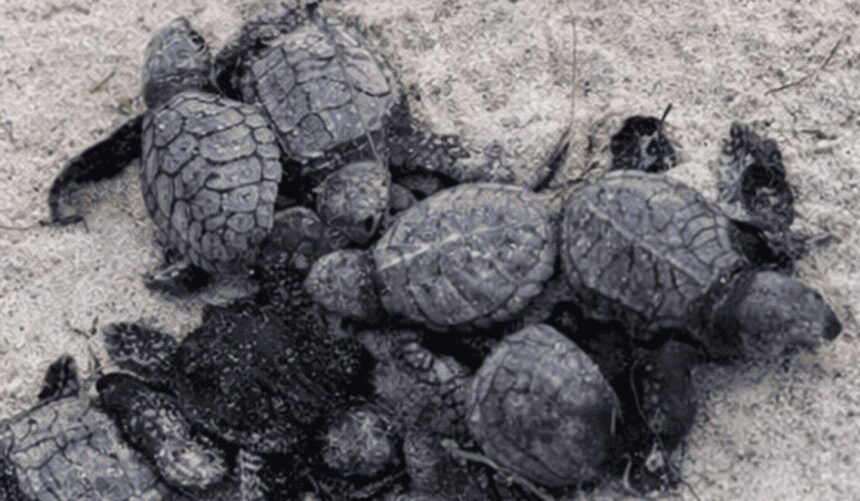
In 2023, more than 150 Olive Ridley hatchlings were rescued, protected, and safely released into the sea through coordinated efforts by local fishermen. While nesting track marks were observed during the 2024 and 2025 seasons, hatchlings could not be located during those years. However, in early February 2026, the beach once again witnessed successful nesting, with over 100 hatchlings safeguarded and released, reaffirming the ecological importance of the site.
The Olive Ridley turtle is globally recognised for its mass nesting behaviour, commonly known as arribada. The repeated nesting events at Teetop Beach highlight its significance as a micro-nesting habitat within the Nicobar group of islands.
In view of the continued nesting and hatchling emergence, researchers and community members have called for the formal designation of Teetop Fish Landing Centre beach as an Olive Ridley nesting site. Such recognition, they say, would help ensure that future developmental activities — including expansion of fish landing facilities, coastal infrastructure projects, and shoreline modifications — are undertaken in alignment with sea turtle conservation strategies.
The development underscores the growing role of community participation in wildlife conservation across the islands and the need to balance coastal development with ecological preservation.