Sri Vijaya Puram | March 13, 2026
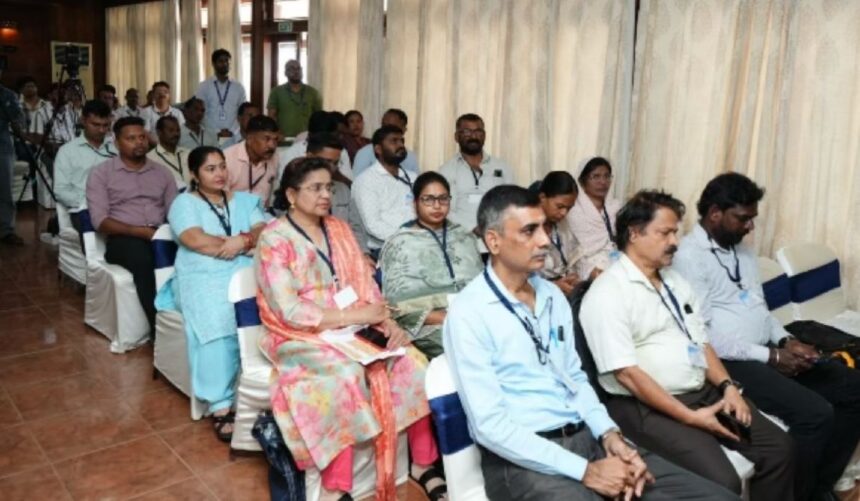
A Union Territory–level workshop on the “Utilization of Outcomes of National Aquifer Mapping and Management (NAQUIM) Phase-I and Phase-II by the A&N Administration” was held on Wednesday at Megapode Resort, bringing together officials, scientists, and experts to deliberate on sustainable groundwater management in the Andaman and Nicobar Islands.
The workshop was organized in hybrid mode by the Central Ground Water Board (CGWB), Eastern Region, Kolkata, under the Ministry of Jal Shakti, Government of India, under the guidance of Ms. Sandhya Yadav, Regional Director, CGWB (ER), Kolkata. Around 110 participants from various line departments of the Andaman and Nicobar Administration attended the programme.
The event was inaugurated in the presence of senior officials, experts from government departments, research institutions, and academic organizations. Dr. Chandra Bhushan Kumar, IAS, Chief Secretary of the Andaman and Nicobar Administration, addressed the gathering and underscored the importance of the NAQUIM programme in strengthening water security and enabling evidence-based policy decisions in the islands.
He also highlighted the need to rejuvenate existing groundwater abstraction structures such as dug wells, many of which have become defunct due to lack of public awareness. Er. T.K. Prijith Rekh, Chief Engineer, APWD, was also present during the inaugural session.
In her keynote address, Ms. Sandhya Yadav emphasized the role of aquifer mapping in ensuring sustainable groundwater management, particularly in ecologically sensitive island regions like the Andaman and Nicobar Islands.
Dr. Jai Sunder, Director of ICAR–Central Island Agricultural Research Institute (CIARI), who attended as the guest of honour, stressed the importance of integrated water resource management to support sustainable agriculture and improve farmers’ livelihoods in the islands. He also highlighted the need to adopt integrated farming systems and precision agriculture to ensure efficient use of limited freshwater resources with minimal wastage.
During the inaugural session, the NAQUIM reports prepared by CGWB and published in 2023, 2024, and 2025 were formally released.
The workshop featured detailed technical sessions led by scientists from CGWB, Eastern Region, Kolkata. Discussions covered key aspects such as aquifer mapping and management, groundwater hydrology, groundwater resource assessment, integrated water resource management with stakeholder participation, groundwater geophysics, hydro-meteorology, groundwater quality, agricultural water management, climatological forecasting, and desalination technologies.
Scientists also presented findings from NAQUIM Phase-I and Phase-II studies conducted in South Andaman, North and Middle Andaman districts, and the Nicobar Islands.
Experts from institutions including Pondicherry University and ICAR-CIARI, along with officials from departments such as APWD, Agriculture Department, and Forest Department, shared insights on local groundwater challenges and agricultural water management practices in island ecosystems.
The programme concluded with an interactive feedback and question-answer session, where representatives from departments including APWD, Agriculture, Military Engineering Services (MES), Dr. B.R. Ambedkar Institute of Technology (DBRAIT), ANIIDCO, and municipal authorities discussed the practical application of NAQUIM outcomes for groundwater planning and sustainable water resource management.
The one-day workshop served as a key platform for scientists, policymakers, and stakeholders to exchange ideas and strengthen coordinated efforts for sustainable groundwater management in the Andaman and Nicobar Islands.