Tarun Karthick
Sri Vijaya Puram, 13 December 2025
A Virat Hindu Sammelan was organised on Saturday, December 13, 2025, at the historic Netaji Stadium in Sri Vijaya Puram, witnessing large-scale participation of Hindus from across the Andaman and Nicobar Islands, spanning from Campbell Bay in the southernmost Nicobar region to Diglipur in North Andaman. The Sammelan saw the convergence of people from diverse regions, communities, traditions, and organisations, reflecting wide participation and strong turnout.
Before the keynote address, Swami Suddhanand Saraswati, Acharya of Chinmaya Mission and Adhyaksh of the Virat Hindu Sammelan Samiti, addressed the gathering.
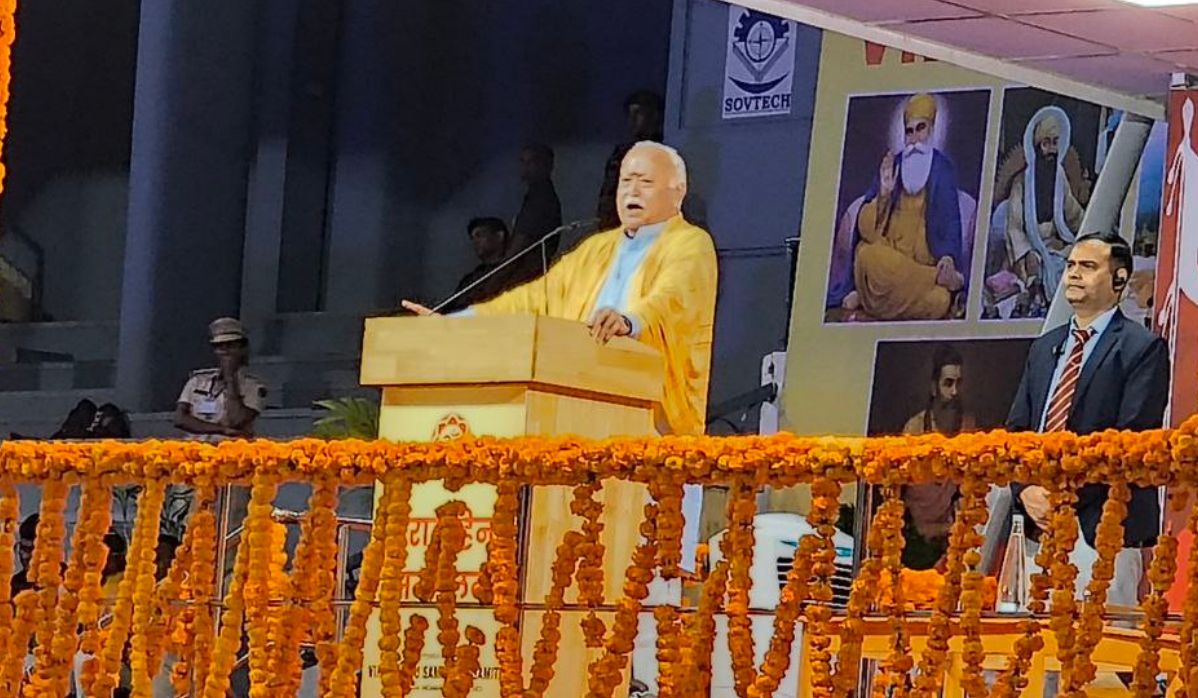
RSS Sarsanghchalak Dr. Mohan Bhagwat, in his detailed address, spoke on themes of unity, organisation, strength, self-awareness, fearlessness, and social harmony within Hindu society. Dr. Bhagwat, referring to a song recited before his address, said that “Hindu jagega toh vishva jagega,” and asserted that global expectations today rest on Bharat to present a way of life rooted in its Sanatan cultural tradition.
Dr. Bhagwat said that while truth is important, the world recognises the strength that stands behind truth, emphasising that power arises from collective organisation rather than individual effort. He repeatedly stressed that strength does not come from internal conflict or division, but from unity and coordinated action. Through several illustrative stories and references from Indian epics, he explained how calm thinking, collective effort, and composure in adversity lead to effective solutions.
Highlighting the importance of understanding circumstances realistically, he cautioned against panic or haste, urging people to focus on solutions rather than endlessly discussing problems. He emphasised that crises also contain opportunities and called upon society to seek progress even in difficult situations.
Dr. Bhagwat underlined unity and fearlessness as the foremost needs of Hindu society today. He stated that Hindu society, according to him, is not in decline but is an “amar samaj” (immortal society), as it has an enduring responsibility towards the world—namely, to uphold and transmit dharma that harmonises individual, society, and nature. Referring to historical civilisations, he said that while many fulfilled their destined roles and faded away, Bharat’s role of sustaining dharma remains ongoing.
He elaborated on the idea that diversity is not division but an ornament of unity, asserting that unity does not require uniformity. He spoke at length on different forms of worship, traditions, languages, customs, and attire, stating that all paths ultimately lead to the same truth and that perceived differences are natural expressions of a civilisation that has evolved over millennia.
Calling for practical action at the family and community level, Dr. Bhagwat outlined steps focused on social harmony, family bonding, environmental responsibility, cultural self-respect, adherence to laws and civic duties, and collective social engagement. He emphasised starting societal change from the family unit, encouraging interaction across social distinctions, strengthening cultural practices at home, protecting the environment, supporting indigenous livelihoods, and living with discipline and responsibility.
He cited examples of collective Hindu organisation abroad to illustrate how coordinated efforts can address common concerns and build confidence within society. Referring to the large gathering present at the Sammelan, he remarked that such participation helps society recognise its own strength and identity.
Concluding his address, Dr. Bhagwat called for fearlessness, unity, and goodwill for all, reiterating the principle of “Sarve Bhavantu Sukhinah” (may all be happy). He expressed hope that the spirit and ideas emerging from the Sammelan in Sri Vijaya Puram would spread across the country and beyond, contributing to the welfare of society at large.