Tarun Karthick
Sri Vijaya Puram, 06 September 2025
In the emerald waters of the Andaman and Nicobar Islands, an unrelenting battle plays out between law enforcement agencies and foreign poachers. The target is not sharks or coral but a humble marine animal that lies almost invisible on the ocean floor: the sea cucumber. Though little known to most Indians, this creature has quietly become one of the most trafficked marine species in the country.
For poachers, the sea cucumber represents a lucrative prize. In China and Southeast Asia, it is served as a delicacy at banquets, processed into tonics, and believed to have medicinal value. Reports by TRAFFIC and WWF-India show that Indian waters have increasingly fed this global demand, with consignments routed through Sri Lanka and onward to markets in China and beyond. Some species can fetch thousands of dollars per kilogram abroad, creating enormous temptation for those willing to risk India’s strict wildlife protection laws. Since 2001, sea cucumbers have been under Schedule I of the Wildlife (Protection) Act, placing them in the same category of protection as tigers and elephants, yet seizures continue to climb.
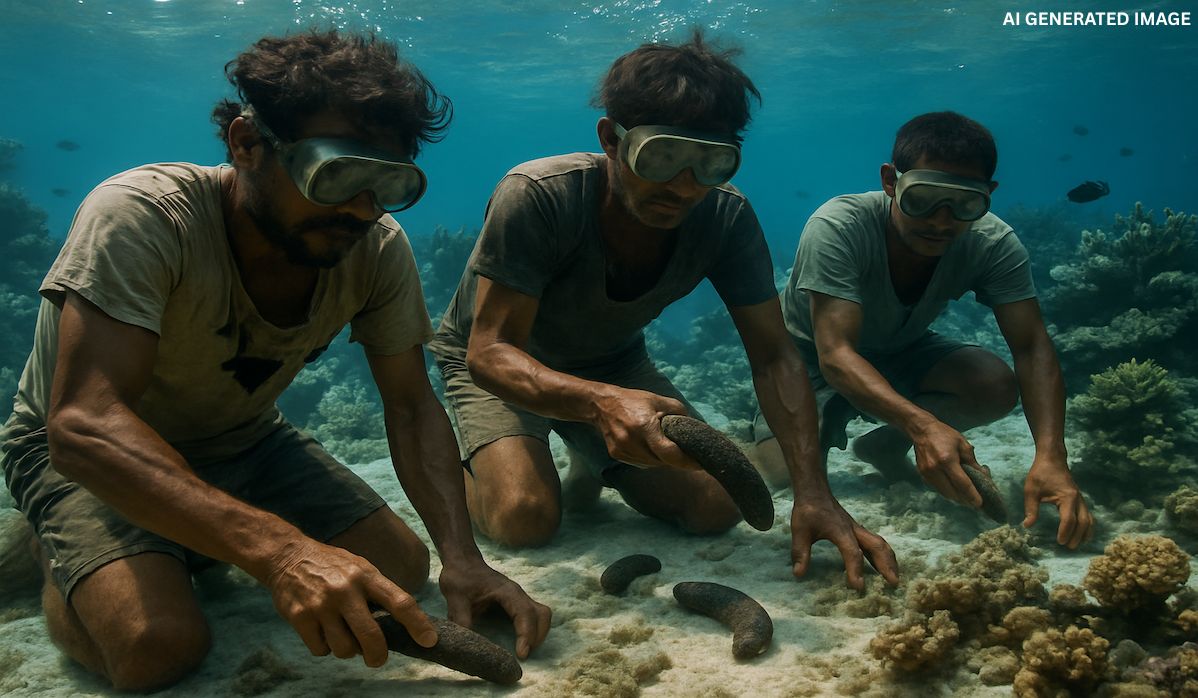
The Andamans are especially vulnerable. Our shallow coral reefs and sprawling seagrass meadows are natural habitats for sea cucumbers, making them easy to collect by hand in shallow waters. The geography of the islands further works in the poachers’ favour. The northern tip of the archipelago lies just a short run from Myanmar, and small boats can slip across under cover of darkness, operate in secluded creeks, and retreat into international waters before dawn. Unlike large-scale fishing operations that demand sophisticated gear, sea cucumber poaching requires little more than diving masks, drums, sacks, and an engine-powered dinghy.
Recent months have provided stark reminders of the scale of the problem. In late August, the Indian Coast Guard intercepted poachers near Mackey Point in North Andaman. The suspects abandoned their dinghy and vanished into the mangroves, leaving behind nearly three hundred and fifty kilograms of sea cucumbers. Barely a week later, Andaman and Nicobar Police launched a sweeping anti-poaching drive across North and Middle Andaman. Over the course of ten days, twenty-three Myanmarese nationals were arrested and more than five hundred kilograms of sea cucumbers were seized, along with two dinghies. Earlier this year, in February, the Navy intercepted another vessel near Barren Island carrying six hundred kilograms of contraband, while a separate seizure near Landfall Island yielded four hundred kilograms. The pattern is consistent: night-time dives and daytime concealment in creeks or jungles.
Beyond the economic dimension lies the ecological cost. Sea cucumbers act as natural cleaners of the seabed, recycling nutrients and aerating sediments, which helps maintain the health of coral reefs and seagrass ecosystems. Their removal threatens the balance of marine life, weakening reef systems, reducing fish stocks, and making fragile ecosystems less resilient to climate change. For an island territory like the Andamans, where livelihoods and food security are closely tied to healthy seas, the loss of these animals poses long-term risks.
Enforcement agencies have responded with stepped-up patrols, community awareness, and multi-agency drives. But the sheer expanse of the archipelago, with its labyrinth of creeks and thousands of kilometres of coastline, makes surveillance a daunting task. Analysts note that the quantities of sea cucumbers seized across India have risen sharply over the past five years, making them the country’s most trafficked marine wildlife. Lakshadweep has already created the world’s first sea cucumber conservation reserve in recognition of the threat, but the Andamans remain especially exposed because of their geography and proximity to international trafficking routes.
As long as the overseas appetite for sea cucumbers remains strong, poachers are likely to keep testing Indian waters. The struggle in the Andamans is no longer just about protecting a species. It is about safeguarding fragile marine ecosystems, defending territorial integrity, and confronting a transnational trade that shows no signs of abating. In this contest, the sea cucumber — once overlooked, almost invisible on the seabed — has become the unlikely symbol of the Andamans’ battle against international wildlife crime.