Capability alone is no permission. The 0→1 Doctrine writes needs and abilities as bands between 0 and 1, checks them against authorised limits before an action and seals a receipt after it, so Artificial, General and Super Intelligence can each be held to a verified permission structure. Band-Based Archive Triage (BBAT), filed September 23 and October 1, 2026, decides from metadata which stored records may be released to AI as bands. This Metainvention defines Authorized Intelligence.
LIVE www.0to1doctrine.com
NEW HERE? THE 0→1 DOCTRINE

The 0→1 Doctrine is a filed system that sits between an AI’s plan and its action. Limits come from law, safety rules and the parties involved. Only an action that passes the gates runs, and a sealed receipt then records what happened.
CAPABILITY IS NOT PERMISSION
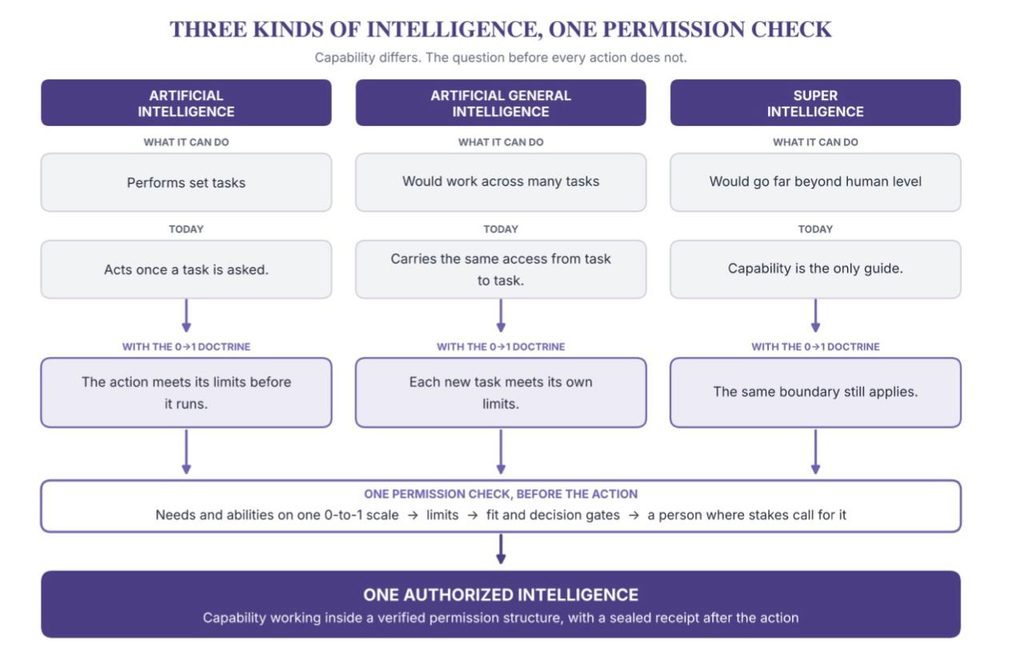
Intelligence describes what a system can do. Permission describes what it may do. The two are often mixed. A very capable system can still lack authority for one particular act, and a narrower system can act freely inside clear limits. Authorized Intelligence is capability that works inside a verified permission structure.
THREE KINDS, ONE QUESTION
Artificial Intelligence performs set tasks well. Artificial General Intelligence would work across many tasks at human level. Superintelligence would go far beyond human level in most fields. Their power differs greatly. Their permission question does not: is this system allowed to take this action, and who confirmed it?
WHERE THE BOUNDARY SITS
The check sits outside the AI. It does not need to read the system’s reasoning, which may be hard to see. It looks only at the proposed action: the needs, the abilities and the limits. Because it stays outside, the same boundary could serve a simple tool today and a far more capable system later.
WHO SETS THE LIMITS
The AI does not set its own limits. They come from authorised, documented rules: law, regulators, sector bodies, contracts or an organisation’s policy. Where rules conflict, the strictest can prevail. Human judgment stays with people, and a person can sit in or on the loop for high-stakes decisions.
A PLAIN EXAMPLE
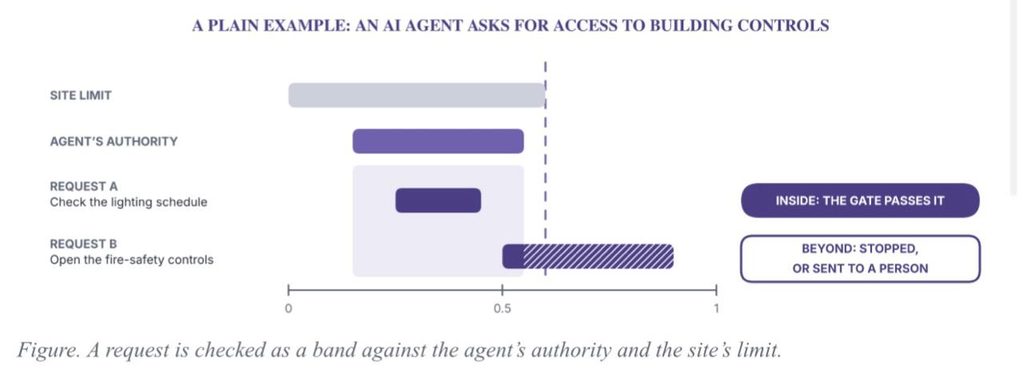
An AI agent asks for access to a building’s control system. The request, the agent’s authority and the site’s limit are each written as a band on one scale. A request inside both the authority and the limit passes. One that goes beyond either is stopped or sent to a person.
WHY NUMBERS
Words are easy to bend. A number between 0 and 1 is easy to compare. Putting needs, abilities and limits on one scale lets very different things be checked the same way: a payment, a medical order, a robot’s movement. The scale does not decide what is right. It makes the comparison plain and keeps it on record.
HOW AN ACTION IS CHECKED
A request moves through a fixed chain. It starts as a need, becomes a user code, meets what is on offer and is compared for fit. Decision gates and legal checks then decide whether it runs. Anywhere along the chain the case can be stopped, rerouted or sent to a person.
WHEN NO RULE EXISTS
Some actions have no written rule. The Doctrine allows authorised, documented rules to come from a contract, an organisation’s policy or a designated decision-maker. The supplier’s declared limits come first, the buyer’s needs sit beside them, and a person has the last word where stakes are high.
ADDING TO LAW, NOT REPLACING IT
The Doctrine does not replace laws, standards or explainable AI. It reads them. Published limits are converted to the common scale, so a regulator’s rule and a supplier’s declared limit can be compared directly. Explanation helps us understand why a system chose; the boundary decides whether it may act.
WARNING BEFORE THE ACT
The Predictive Risk Advisory Token, or PRAT, is a warning layer. It reads trends such as drift and early signs of failure, and can send an advisory before a risky action commits. It advises; it does not authorise. The gates remain the authority on whether an action may run.
SEEING THE WHOLE SYSTEM
EMERGE, the Emergent Meta-Environmental Response and Governance Envelope, looks beyond one transaction. It reads aggregated indicators to spot slow deterioration across a whole system and signals it for review. It takes no part in the action itself. It is awareness, not a second gate, and it works at the level of the whole system.
THE RECEIPT AFTER THE ACT
After an approved action runs, the system issues an Actuation Compliance Receipt. It is cryptographically sealed and records what was decided, which limits applied and what was done. A later review can then rest on a record, not on memory or on a system’s own account of itself.
A SECOND FILING: STORED DATA
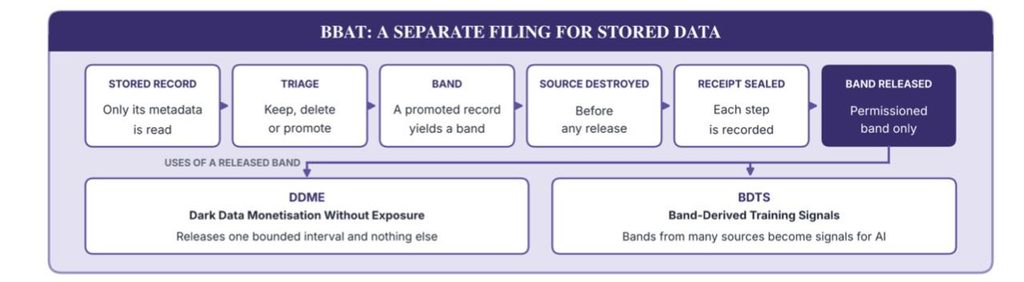
A second filing covers the data side. Band-Based Archive Triage, or BBAT, reads only the metadata of stored records and decides whether each is kept, deleted or promoted. A promoted record yields a permissioned band, the source records are deleted inside the secure environment before release, and a sealed receipt records each step. Then DDME (Dark Data Monetisation Without Exposure) releases one bounded interval, so data gains value without exposing records. BDTS (Band-Derived Training Signals) turns bands from many sources into AI training signals with no identity. BBAT is a separate filing.
WHY IT MATTERS NOW
Debate about advanced AI often turns on whether systems stay controllable as they grow more capable. A permission boundary offers a different answer: control the action, not the intelligence.
THREE QUESTIONS FOR ANY AI
Three questions suit any system, small or large. What is it about to do? Which limits apply, and who set them? Where is the record afterwards? An AI that can answer all three is closer to Authorized Intelligence.
QUICK ANSWERS
| What is Authorized Intelligence? | Capability that operates inside a verified permission structure. |
| What is a band? | A short range on a 0-to-1 scale, used in place of one exact number. |
| Which sectors? | The filing is sector-agnostic: finance, health, infrastructure, robotics and more. |
| Is a person always involved? | A person can be placed in or on the loop where stakes call for it. |
| Who benefits first? | Teams deploying AI agents that move money, access or infrastructure. |
| A complete shield? | It is a layer of limits, warning and proof. It does not promise to stop every determined opponent or make any system infallible. |
CLOSING NOTE
Intelligence will keep growing. Let permission grow with it: ask what it can do, then ask what it may do.
LIVE www.0to1doctrine.com
This can be tested, live, via API, governed against ungoverned, side by side.
THE INVENTOR
Systems theorist, inventor, and serial entrepreneur Vatsal Soin holds grants in the US, Japan, India and more; filings span six continents; latest grant, AI footwear, August 2026. Inventions: footwear, apparel fit, Sharable Size Cards, digital twins, robotics, global governed data, archive triage, quantum-resilient cryptography, AI governance. SIM–RMIT and NTU alumnus. Every prior invention was a step; 0→1 is the destination.
SELECTED REFERENCES
Granted: US Patent 12,446,652 B2 · Japan Patent 7560909 · India Patents 454081 and 599317. Filed: PCT/IN2025/051943 · US 19/489,595 · India 202511115781 · Australia AU2022450649 · India 202611113867 (23 September 2026) · PCT/IN2026/052042 (1 October 2026).
DISCLAIMER
Informational only. Not certified. No endorsement implied. Not investment advice. Examples are illustrative, not field results. Vatsal Soin · © 2026 All Rights Reserved.