Factories build to forecasts, services sell slots that go unfilled, and assets lose value standing still. Two filed Metainventions are designed to reverse that order, in any field and at any scale. Needs and capabilities become bands on one 0-to-1 line, and making or serving is authorised only when they overlap. Failed matches can be rerouted, idle capacity can find buyers, and stored records can be purged or promoted.
| THE PAIR IN BRIEF The 0→1 Doctrine is a filed invention that turns any need or capability, from one clinic slot to a nation’s freight network, into a band between 0 and 1. AI may authorise making, moving or serving only when bands overlap, and each outcome is sealed in a receipt. BBAT (Band-Based Archive Triage), a second filing, applies the same line to stored records, new or old. This article covers unsold goods, unused services and idle assets. |
THE COST OF GUESSING
Much of today’s supply runs on averages. Goods are made for a guessed buyer, then marked down or thrown away. Services are booked, then cancelled. Machines and buildings sit half used. From a street stall to a global supply chain, the cause is the same: commitment comes before a real match.
SERVICES LOSE MORE THAN GOODS
An unsold shirt can wait for next season. An empty flight seat, an unbooked clinic hour or an idle hotel room is gone for good once the moment passes. That is why the Doctrine’s filing treats product manufacturing and service allocation on equal terms.
MATCH BEFORE YOU MAKE
A buyer’s need is captured as User System Parameters and turned into a User Compliance Code. A Product Design Token then states what must be made or delivered. A supplier declares what it can do as an Asset Capability Token. A Service-Product Fit Score compares need and capability, and a Manufacturing Authorization Token releases work only when the bands overlap and legal, safety and regulatory checks pass.

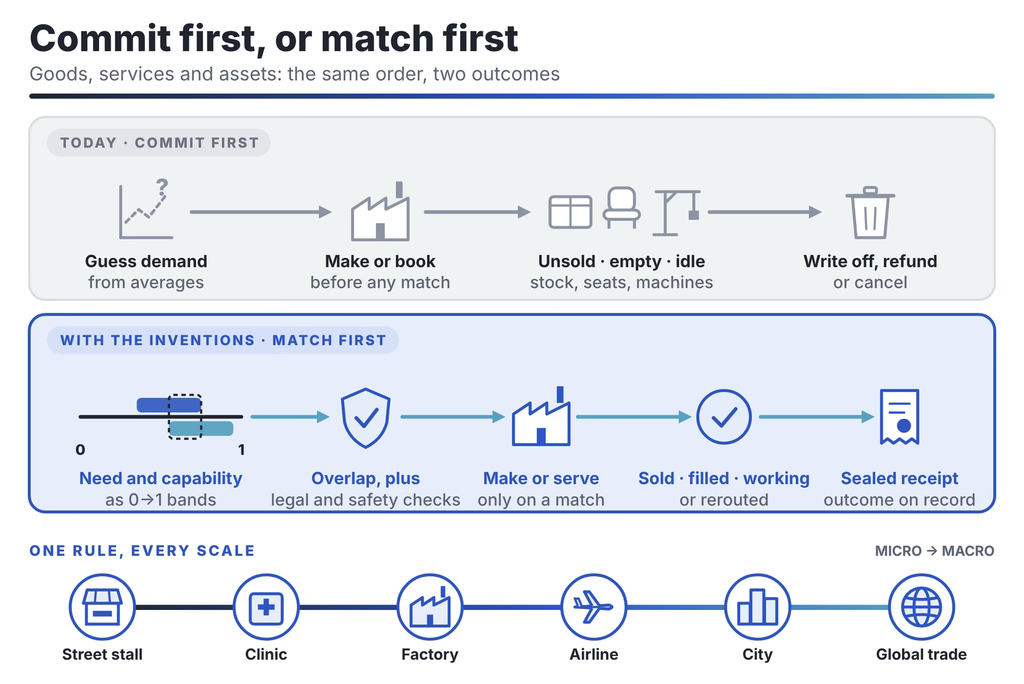
Figure 1. Commit first, or match first: one rule at every scale.
FEWER CANCELLATIONS, MORE REROUTING
Some cancellations begin as surprises: a machine down, a certificate expired, capacity overbooked. The capability check is designed to catch such gaps before commitment. When a match still fails, options include approval with conditions, a redesign, an alternate supplier, or a refusal with a reason. A failed match need not end the order.

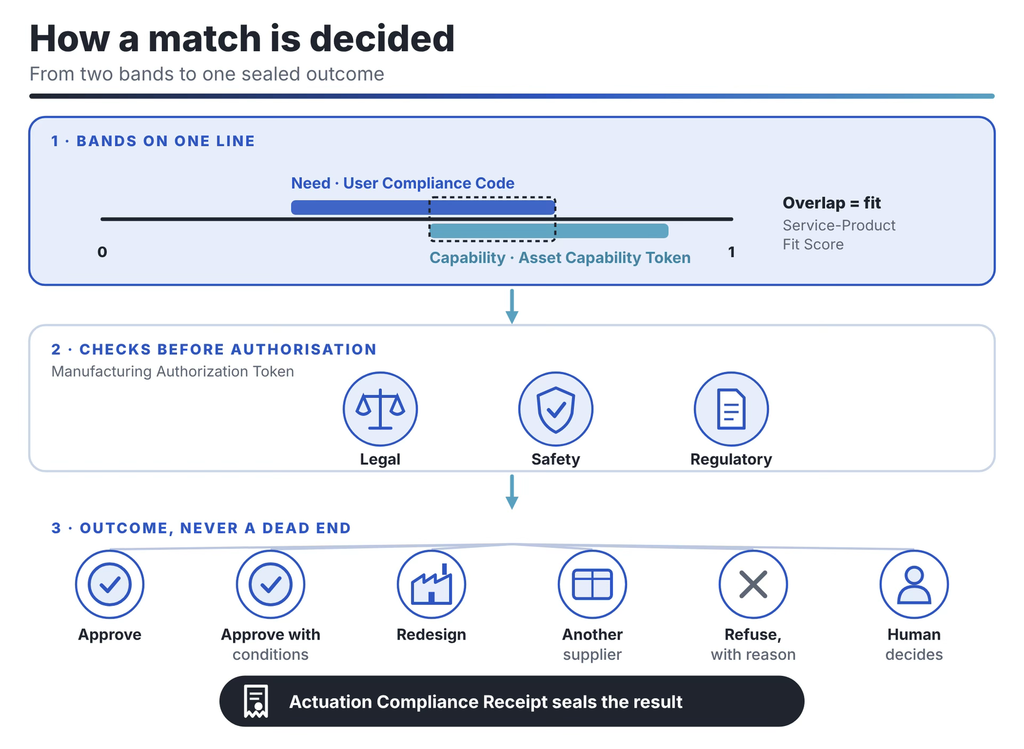
Figure 2. How a match is decided.
STOCK AND CAPACITY THAT FIND BUYERS
The filing also runs the match in reverse. A supplier’s declared capability becomes the starting point for finding demand that fits. Unsold stock, free appointment slots and spare machine hours can surface to buyers whose needs already match. That can be income that would otherwise be missed.
ASSETS PUT BACK TO WORK
An Asset Capability Token is a live, reusable declaration of what an asset can do. A crane, a cold store or a clinic’s free afternoon stays visible to matching demand. Higher use can slow the erosion of capital, and each hour put to work can earn.
PRIVACY KEEPS PARTNERS TRADING
Matching usually demands disclosure: buyers reveal needs, suppliers reveal costs and capacity. Here the design keeps a buyer’s raw details on its own system and sends only bands, while a supplier’s capability token carries no link to any buyer. Less exposure can mean more partners willing to join.
WARNINGS AND COURSE CORRECTION
A Predictive Risk Advisory Token can flag likely failures early, and the Fair & Transparent Waste Estimator turns waste, time loss and misallocation into 0-to-1 indices that weigh on each decision. While work runs, the Orchestration and Compliance Token can pause, redirect or reallocate connected operations, and substitutes can keep supply moving.
REPAIR, WITH PROOF
If something still goes wrong, the Post-ACR Remediation and Resolution Framework can start rework, reassignment or, where possible, rollback. The Actuation Compliance Receipt records the conditions, bands and outcome without raw data, giving auditors, insurers and trading partners evidence they can check. Disputes can narrow to what the receipt shows.
DEAD DATA IS DEAD STOCK TOO
Records kept past their use cost money, carry risk and can lose value. BBAT first reads only labels such as age, consent and legal hold, then marks each record retain, purge or promote under authorised rules. Purging can cut storage cost. Promoted records yield bands, derived in the holder’s secure vault, that can earn as AI training signals where permitted.
WHAT IT CAN BE WORTH
For the Doctrine, savings can come from fewer write-offs, markdowns, refunds and reworks; income from stock, slots and machine hours matched to new demand. For BBAT, savings can come from lower storage and exposure cost; income from governed bands, a route its filing names. Figure 3 compares them.

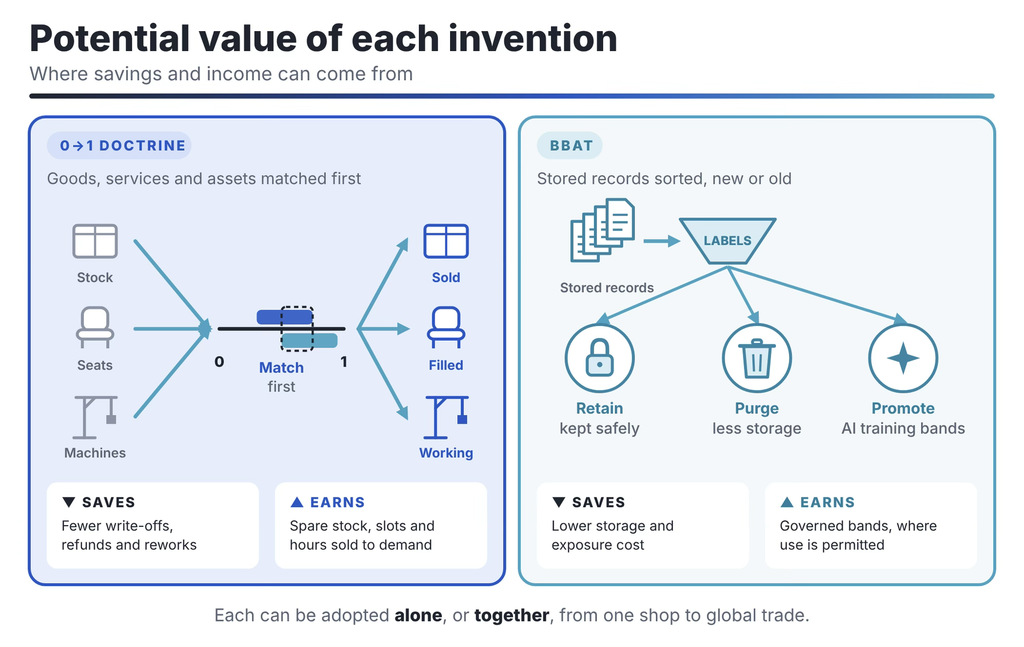
Figure 3. Potential value of each invention.
HUMANS STAY IN CHARGE
Recognised authorities and domain experts set the ranges, drawing on published standards. Risk signals are advice, and human operators keep control. Cases that need judgment go to a human. Limits are reviewed as standards change. AI works inside those limits; it does not set them.
BEFORE SUPERINTELLIGENCE
Superintelligence has not arrived, and these filings do not claim to build it. However capable future planning systems become, the rule they would meet is the same: declare the need, check the capability, make or serve only on a match. A smarter forecast still answers to a real buyer.
QUESTIONS ON READERS’ MINDS
| Does it suit small shops and clinics? Yes. Tokens can travel by SMS, voice menus, QR codes or paper forms, then sync once a connection returns. | Must existing systems be replaced? Adapter layers can connect the line to existing planning, factory and control software. |
| Can a service be substituted? Yes. The filing names alternate service providers among possible substitutes. | What if several suppliers fit? The filing describes settling it by fit, capacity, sustainability and fairness rules. |
| How is a saving shown? The estimate sealed at the decision can later be compared with the real outcome against an agreed baseline. | Can the two be adopted separately? Either works alone. One matches goods, services and assets; the other sorts the records behind them. |
CLOSING NOTE
Make what is wanted, serve who is waiting, and let no shelf, seat or server hold what no one asked for.
LIVE www.0to1doctrine.com
This can be tested, live, via API, governed against ungoverned, side by side.
THE INVENTOR
Systems theorist, inventor, and serial entrepreneur Vatsal Soin holds grants in the US, Japan, India and more; filings span six continents; latest grant, AI footwear, August 2026. Inventions: footwear, apparel fit, Sharable Size Cards, digital twins, robotics, global governed data, archive triage, quantum-resilient cryptography, AI governance. SIM–RMIT and NTU alumnus. Every prior invention was a step; 0→1 is the destination.
SELECTED REFERENCES
Granted: US Patent 12,446,652 B2 · Japan Patent 7560909 · India Patents 454081 and 599317. Filed: PCT/IN2025/051943 · US 19/489,595 · India 202511115781 · Australia AU2022450649 · India 202611113867 (23 September 2026) · PCT/IN2026/052042 (1 October 2026).
DISCLAIMER
Informational only. Not certified. No endorsement implied. Not investment advice. Examples are illustrative, not field results. Vatsal Soin · © 2026 All Rights Reserved.