Sri Vijaya Puram | March 23, 2026
Tarun Karthick
April 23, 1969, marks a defining yet often under-acknowledged moment in India’s strategic and developmental history. On that day, the first batch of Ex-Servicemen Settler Families arrived on Great Nicobar Island—over 2700 kilometres away from their homes in Punjab. Disembarking from MV Andamans onto a modest wooden jetty at what is now the Police Marine Force area in Campbell Bay, they stepped into an unforgiving wilderness. With that step began not just a settlement, but the foundation of Great Nicobar’s modern story.
This was no ordinary migration. In the aftermath of the 1962 Indo-China war, India recalibrated its strategic priorities. Great Nicobar, the southernmost frontier of the nation, assumed critical importance. The decision to settle 1000 Ex-Servicemen families from different parts of the country was not merely developmental—it was geopolitical. These families were to serve as both settlers and sentinels, ensuring a permanent patriotic presence in a vulnerable maritime zone.
The settlement continued in phases—1970, 1974, 1977, 1979, and 1980—eventually bringing 330 Ex-Servicemen families to the island before the scheme was discontinued. What they encountered was not opportunity, but adversity. Dense forests, lack of infrastructure, and total isolation defined their early years. Every road, every structure, every cultivated field was carved out of sheer determination.
Today, nearly 57 years later, Great Nicobar stands on the brink of a transformation of historic proportions. The Government of India’s ambitious holistic development plan envisions a transshipment port, a greenfield international airport, a power plant, a township, and tourism infrastructure. This grand vision aligns with the national aspiration of Viksit Bharat 2047, promising to convert Great Nicobar into a key commercial and strategic hub.
Ironically, the very communities that laid the groundwork for this transformation—the Ex-Servicemen Settler Families—find themselves in a paradox of hope and discontent.
For decades, these settlers waited for development. As early as the 1970s, the idea of a “Free Port” had ignited their aspirations, an idea they supported wholeheartedly but never saw realized. Today, as development finally arrives, they welcome it. But their support is tempered by a growing sense of injustice.
At the heart of their concern lies the issue of land compensation.
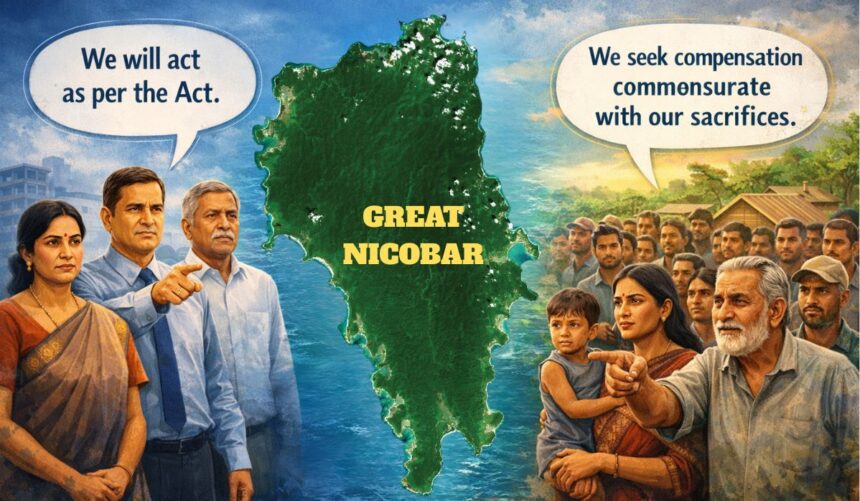
The notified circle rates for land in Gandhi Nagar and Shastri Nagar—the two principal villages of these settlers—stand at a mere Rs. 131 and Rs. 113 per square metre respectively, even in the 2024 notification issued well after the announcement of the holistic development project. Under the framework of The Right to Fair Compensation and Transparency in Land Acquisition, Rehabilitation and Resettlement Act, 2013, compensation is intrinsically linked to these rates. The result: payouts that settlers fear will be grossly inadequate.
This has led to a troubling perception among the settlers—that the circle rates have been deliberately kept low to facilitate land acquisition at minimal cost. Whether this perception is accurate or not, it reflects a deep erosion of trust at a critical juncture.
To understand this grievance, one must revisit the lived realities of these families.
Great Nicobar was never an easy assignment. Its remoteness from Sri Vijaya Puram (Port Blair), the administrative capital, meant chronic neglect. The settlers, many of whom turned to agriculture, found themselves cut off from viable markets. Even perishable produce like vegetables could not be exported efficiently. Despite strong production capacity, they were forced to sell locally at negligible profits.
Developmental attention from the administration remained limited, largely due to the island’s distance and logistical challenges. The low land values today are not a reflection of the settlers’ efforts or the intrinsic worth of the land, but a direct consequence of decades of systemic neglect and isolation—circumstances beyond their control.
Then came the devastating blow of the 2004 tsunami.
The disaster displaced these families from their homes in Gandhi Nagar and Shastri Nagar, forcing them into cramped temporary shelters—tin structures behind the Primary Health Centre in Campbell Bay—for more than seven years. The tsunami did not break their spirit, but it erased decades of progress, pushing them back to conditions reminiscent of the 1970s. Once again, they rebuilt—from scratch.
And now, history threatens to repeat itself.
With land acquisition underway for the Greenfield International Airport, these families face displacement yet again—the third time in less than five decades. This is not just a question of land; it is a question of dignity, legacy, and justice.
Each Ex-Servicemen family in Gandhi Nagar and Shastri Nagar was originally allotted 11 acres of land as an incentive to settle in Great Nicobar. That land was more than property—it was compensation for leaving behind stable lives in mainland India, a promise of security, and an asset meant to be passed down generations.
Four generations have since lived, struggled, and contributed to the island’s development. To now offer compensation that does not reflect this history would be a grave injustice.
The settlers are not opposing development. On the contrary, they are among its strongest supporters. But they seek fairness—compensation that acknowledges not just the market value of land, but the human cost embedded within it.
Their expectation is simple: that the Government of India and the Andaman and Nicobar Administration recognize their sacrifices and ensure a rehabilitation and compensation package that is both just and compassionate.
Even today, despite growing anxiety, hope persists among these families. They believe that the government cannot remain indifferent to their contributions. They trust that fairness will prevail.
As Great Nicobar prepares to step into a new era, the question is not whether development should proceed—it must. The real question is whether this development will honour those who made it possible, or overlook them in the pursuit of progress.