Chennai | March 10, 2026
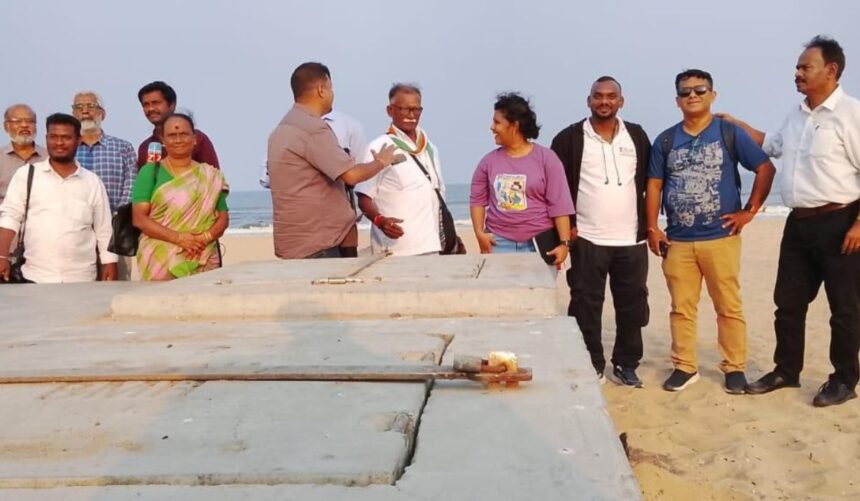
A team of journalists from the Andaman and Nicobar Islands visiting Chennai as part of a press tour organised by the Press Information Bureau (PIB) on Monday visited the Beach Manhole (BMH) of the Chennai–Andaman and Nicobar Islands (CANI) Submarine Optical Fibre Cable project at Santhome Beach. The journalists were briefed by officials of Bharat Sanchar Nigam Limited (BSNL) about the functioning, significance and technical aspects of the undersea cable that serves as the digital lifeline of the Islands.
During the visit, the journalists were taken to the Beach Manhole — the point where the submarine optical fibre cable emerging from the seabed reaches the shore before being connected to the cable landing station through land cables. Senior BSNL officials explained the infrastructure and the role it plays in maintaining seamless telecom connectivity between mainland India and the Andaman and Nicobar Islands.
The Chennai–Andaman and Nicobar Islands (CANI) submarine optical fibre cable project was inaugurated by the Prime Minister, Narendra Modi, on August 10, 2020, marking a major milestone in improving digital connectivity in the remote island territory. The project involved laying around 2,300 km of submarine optical fibre cable under the Bay of Bengal connecting Chennai with Port Blair and several other islands.
Prior to the commissioning of the CANI project, the Andaman and Nicobar Islands were largely dependent on satellite-based connectivity, which had limited bandwidth and high latency, resulting in slow internet speeds and restricted data capacity. The submarine cable dramatically improved internet bandwidth, enabling faster mobile and broadband services across the islands.
The project was funded by the Department of Telecommunications (DoT) through the Universal Service Obligation Fund (USOF) — now known as the Digital Bharat Nidhi — with BSNL acting as the implementing agency responsible for laying and maintaining the cable network.
Officials explained that the cable system also connects Port Blair with seven other islands including Swaraj Dweep (Havelock), Long Island, Rangat, Little Andaman (Hut Bay), Car Nicobar, Kamorta and Great Nicobar, enabling high-speed telecom connectivity across the archipelago.
During the interaction, the Principal General Manager of BSNL briefed the visiting journalists about the technical aspects of the project. According to the official, the submarine optical fibre cable from Chennai to Port Blair stretches nearly 1,500 km under the sea, forming the backbone of digital connectivity for the island territory.
He explained that eight cable landing stations have been established across the islands, where the undersea cable terminates and is connected to land-based optical fibre networks. Each landing point receives the cable through a beach manhole before it is connected to the main telecommunications infrastructure.
To ensure reliability, the land cable between the beach manhole and the cable landing station has been laid through two separate routes — Path A and Path B. This redundancy helps maintain connectivity in case one route is accidentally damaged during construction or other activities.
The official further noted that the optical fibre cable system has extremely high bandwidth potential, with capacity limited only by the terminal equipment installed at either end. At present, the system has operating capacity of around 400 gigabits per second, but capacity can be expanded in the future simply by upgrading terminal equipment without replacing the fibre itself.
He also revealed that the submarine cable consists of four fibre pairs, of which:
- Two fibres are used for the main operational link and standby redundancy
- One fibre is reserved for defence communications
- One fibre remains available as a spare for future needs
Responding to questions from journalists regarding disruptions in connectivity, the BSNL official confirmed that one major cable fault occurred in 2025 near Car Nicobar, which affected connectivity to the Nicobar region including Kamorta and Great Nicobar.
He said the issue was rectified within about one month, which is significantly faster than the typical restoration period for submarine cables worldwide, which can take three to six months. Restoration involved deploying specialised ships and remotely operated underwater vehicles to inspect the damaged cable and splice a new section.
Based on visual inspection during repairs, officials indicated that the damage may have been caused by an anchor from a ship.
During the outage, connectivity to affected areas had to temporarily revert to satellite bandwidth, which is significantly slower and more limited compared to fibre connectivity.
During the interaction, journalists also raised concerns regarding several inhabited islands such as Katchal and Shaheed Dweep that still face connectivity challenges. Responding to the query, the BSNL official said that decisions regarding expansion of submarine cable networks are taken by the Department of Telecommunications and the Government of India, and BSNL is responsible primarily for implementation.
He indicated that there are plans under consideration to establish another submarine cable route connecting the islands from a different direction, possibly from the eastern coast of India, which could provide redundancy and enable connectivity to additional islands.
Such a project would require multiple stages of approval including government and cabinet clearance, given the large capital investment involved.
Responding to questions about security of the cable infrastructure, BSNL officials explained that the coordinates of the submarine cable route have been shared confidentially with defence authorities including the Indian Navy and the Andaman and Nicobar Administration.
Officials also stated that 24×7 monitoring and periodic patrolling are conducted around cable landing points and beach manholes to prevent damage from maritime activities. Personnel are deployed to regularly inspect the locations and report any suspicious activity.
Despite the vulnerability of submarine cables to external factors such as anchors and fishing gear, officials noted that only one major incident has been recorded since the project became operational nearly six years ago.
During the discussion, journalists also asked whether emerging satellite internet services could replace submarine cables in the future. The BSNL official explained that while satellite internet technologies are advancing, submarine fibre cables remain the backbone of global internet infrastructure.
He pointed out that once laid, fibre cables offer vast bandwidth capacity at relatively lower operational costs, whereas satellite bandwidth remains limited and expensive due to constraints such as transponder capacity and satellite size.
Most global telecom operators, cloud service providers and internet infrastructure companies rely on submarine cables to transmit large volumes of data across continents, making them indispensable for modern digital communication.
Officials emphasised that the CANI project has played a crucial role in bringing the Andaman and Nicobar Islands closer to the digital mainstream, enabling improved services such as high-speed broadband, mobile connectivity, telemedicine, online education, banking and e-governance.
With increasing digital demand in the islands and the government’s focus on expanding digital infrastructure, the submarine cable system is expected to continue serving as the backbone of connectivity for the archipelago in the years ahead.
The visiting journalists expressed appreciation for the opportunity to understand the technical infrastructure that supports communications in the Andaman and Nicobar Islands and interacted extensively with BSNL officials during the visit.