Sri Vijaya Puram | July 24, 2026
The Andaman & Nicobar Pollution Control Committee (ANPCC), functioning under the Department of Science & Technology, A&N Administration, has initiated action for the effective implementation of the Stockholm Convention on Persistent Organic Pollutants (POPs) in the Islands. The exercise is being undertaken in compliance with the directions of the Ministry of Environment, Forest & Climate Change (MoEF&CC) and the Central Pollution Control Board (CPCB) as part of India’s commitments under the international environmental treaty.
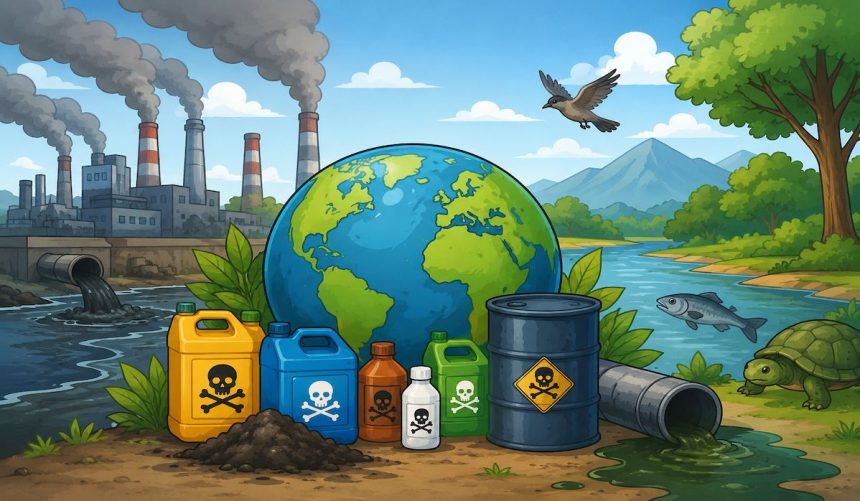
Persistent Organic Pollutants (POPs) are highly toxic chemical substances that remain in the environment for long periods without breaking down. These chemicals accumulate in living organisms through the food chain and pose significant risks to human health, wildlife and ecosystems. Due to their persistence and ability to travel long distances through air and water, POPs have emerged as a global environmental concern requiring coordinated international action.
The Stockholm Convention, which came into force in 2004, is a global environmental treaty aimed at protecting human health and the environment from the harmful effects of Persistent Organic Pollutants. At present, the Convention lists 37 Persistent Organic Pollutants comprising pesticides and industrial chemicals under three annexes that deal with the elimination, restriction and reduction of unintentional releases of these hazardous substances.
India ratified the Stockholm Convention in 2006 and has so far ratified 19 Persistent Organic Pollutants. These include Aldrin, Chlordane, Chlordecone, Dieldrin, Endrin, Heptachlor, Hexabromobiphenyl, Hexabromocyclododecane (HBCD), Hexabromodiphenyl ether and Heptabromodiphenyl ether, Hexachlorobenzene, Hexachlorobutadiene, Mirex, Pentachlorobenzene, Polychlorinated Biphenyls (PCBs), Tetrabromodiphenyl ether and Pentabromodiphenyl ether, Toxaphene, DDT, Polychlorinated dibenzo-p-dioxins (PCDD) and Polychlorinated dibenzofurans (PCDF).
The remaining 18 chemicals listed under the Stockholm Convention, which are yet to be ratified by India, include Chlorpyrifos, Decabromodiphenyl ether (commercial mixture, c-decaBDE), Dechlorane Plus, Dicofol, Alpha Hexachlorocyclohexane (α-HCH), Beta Hexachlorocyclohexane (β-HCH), Lindane, Long-chain Perfluorocarboxylic Acids (LC-PFCAs), their salts and related compounds, Medium-chain Chlorinated Paraffins (MCCPs), Methoxychlor, Pentachlorophenol and its salts and esters, Polychlorinated Naphthalenes (PCNs), Perfluorooctanoic Acid (PFOA), its salts and PFOA-related compounds, Perfluorohexane Sulfonic Acid (PFHxS), its salts and PFHxS-related compounds, Short-chain Chlorinated Paraffins (SCCPs), Technical Endosulfan and its related isomers, UV-328, and Perfluorooctane Sulfonic Acid (PFOS), its salts and Perfluorooctane Sulfonyl Fluoride (PFOSF).
To regulate the Persistent Organic Pollutants already ratified by India, the Ministry of Environment, Forest & Climate Change has notified the Regulation of Polychlorinated Biphenyls Order, 2016 and the Regulation of Persistent Organic Pollutants Rules, 2018. These legal provisions prohibit the manufacture, use, import, export and trade of the notified Persistent Organic Pollutants across the country, while compliance with the regulations is monitored by the concerned regulatory authorities.
As part of the current exercise, the ANPCC is collecting information relating to the 18 non-ratified Persistent Organic Pollutants to assess their production, import, export, domestic sales, in-house consumption and stockpiles in the Islands. The information collected will be forwarded to the Ministry of Environment, Forest & Climate Change, Government of India, to assist in evaluating the status of these chemicals and facilitate informed decision-making regarding India’s future obligations under the Stockholm Convention.
The Committee has, therefore, called upon all industrial units, manufacturers, importers, exporters, traders, research institutions, laboratories, educational institutions, government organisations and other establishments dealing with any of the chemicals listed under the Stockholm Convention to furnish the requisite information in the prescribed format.
The required information should be submitted to the Member Secretary, Andaman & Nicobar Pollution Control Committee, Department of Science & Technology, A&N Administration, Dollygunj, Sri Vijaya Puram, South Andaman, on or before July 27, 2026. The information may also be submitted through email at [email protected].
The ANPCC has informed that the detailed list of both ratified and non-ratified Persistent Organic Pollutants, along with the prescribed reporting formats, is available on its official website.
Appealing for cooperation from all concerned stakeholders, the ANPCC has urged eligible establishments and organisations to furnish the required information within the stipulated timeframe to facilitate the effective implementation of the Stockholm Convention and strengthen the management of hazardous chemicals in the Andaman & Nicobar Islands.